The foreign exchange market, or forex, is where currencies are bought and sold. Roughly $7.5 trillion changes hands each day (BIS Triennial Survey, 2022), making it the largest and most liquid financial market in the world. Understanding the basics is the starting point for anyone considering trading currencies.
What is traded in forex?
In forex, you always trade one currency against another. These are called currency pairs. When you buy EUR/USD, you are buying euros by selling US dollars. If the euro rises against the dollar, your position gains value. If it falls, you lose.
The price of a currency pair reflects how many units of the quote currency (the second one) you need to buy one unit of the base currency (the first one). EUR/USD at 1.0850 means one euro costs $1.0850.
Who actually trades forex?
The forex market has several distinct layers, each with different motivations and trading sizes.
Central banks
Central banks — including the US Federal Reserve, the European Central Bank, and the Bank of England — intervene in currency markets to manage exchange rate stability or implement monetary policy. When the Bank of Japan sold yen reserves in 2022 to arrest a sharp depreciation, it was participating directly in the forex market. Central banks also hold foreign exchange reserves, which requires ongoing currency management. Their decisions on interest rates have a far larger indirect impact on exchange rates than any direct intervention.
Commercial and investment banks
Major banks such as JPMorgan, Deutsche Bank, Citibank, and Barclays sit at the top of the interbank market, trading enormous volumes between themselves. They act both as principals (trading for their own book) and as intermediaries, passing client orders through. The interbank market sets the benchmark prices that all other participants reference. Banks also hedge their own currency exposure from cross-border lending and investment activities.
Hedge funds and institutional investors
Macro hedge funds — such as those following in the tradition of George Soros’s famous 1992 bet against the pound — take large directional positions based on economic analysis, geopolitical themes, or quantitative models. Asset managers running global equity or bond portfolios routinely hedge their currency exposure or take tactical currency positions. These participants contribute significant volume and can drive short-term trends in major pairs.
Corporations
A UK company that invoices US clients in dollars faces currency risk: if the pound strengthens, those dollar revenues are worth less when converted. Corporations use the forex market to hedge that exposure, converting foreign revenues and managing the cost of imports. This hedging activity creates consistent and predictable flow in certain currency pairs.
Retail traders and brokers
Retail traders access the forex market through brokers, who themselves access liquidity from banks and electronic communication networks (ECNs). Most retail brokers in the UK offer forex through CFDs or spread bets — you are not physically exchanging currency, but speculating on price movements with your broker as counterparty or intermediary. Retail traders constitute a small fraction of total market volume, but they are a growing segment.
How do the 24-hour trading sessions work?
Forex trades 24 hours a day, five days a week, following the sun around the globe. The market opens Sunday evening New York time and closes Friday evening, cycling through four major sessions:
- Sydney session — Opens first as the week begins in Australasia. Typically the quietest session for major pairs, though AUD and NZD pairs see their best liquidity here. Roughly midnight to 9am UK time.
- Tokyo (Asian) session — Japan is the third-largest forex trading centre globally. USD/JPY, AUD/JPY, and other yen pairs are most active here. Roughly midnight to 9am UK time, overlapping with Sydney.
- London session — The largest single trading centre by volume, accounting for over 38% of global daily forex turnover (BIS 2022). EUR/USD, GBP/USD, and most major pairs hit their tightest spreads and highest volume here. Roughly 8am to 5pm UK time.
- New York session — The second-largest centre. Overlaps with London from roughly 1pm to 5pm UK time, creating the highest-liquidity window of the trading day. US economic data releases hit during this overlap, driving sharp moves in USD pairs.
The London–New York overlap is consistently the most active period for major pairs. If you are trading EUR/USD or GBP/USD and want the tightest spreads and smoothest execution, these four hours are the optimal window. Conversely, trading major pairs during the Asian session (outside the Tokyo session’s native pairs) often means wider spreads and slower, choppier price action.
What moves forex prices?
Several categories of driver move exchange rates, operating across different time horizons.
Interest rate differentials
The single most important long-term driver of currency values is the interest rate differential between two countries. When a central bank raises rates, investors can earn a higher return on assets denominated in that currency, attracting capital flows and strengthening the currency. The Fed’s aggressive rate hiking cycle from 2022 to 2023 — taking the federal funds rate from near zero to over 5% — drove significant dollar strength. EUR/USD fell from 1.15 to below parity (1.00) in 2022 as the rate differential shifted sharply in the dollar’s favour.
Inflation data
CPI (Consumer Price Index) and RPI releases are among the most market-moving scheduled events. If inflation comes in above expectations, the market prices in a higher probability of future rate hikes, which strengthens the currency. If inflation undershoots, rate cut expectations increase and the currency typically weakens. UK CPI data routinely moves GBP pairs by 50–100 pips on release.
Employment figures
The US Non-Farm Payrolls (NFP) report, released on the first Friday of each month, is one of the single most anticipated data points in forex. A strong jobs number signals economic health and supports dollar strength. A weak number raises recession concerns and typically weakens the dollar. UK employment data — including the unemployment rate and wage growth figures — is a key driver of GBP.
Geopolitical events
Wars, elections, referenda, and trade disputes all affect currency values. Brexit drove multi-year volatility in GBP pairs, taking GBP/USD from near 1.50 in mid-2016 to below 1.20 by the end of that year. Geopolitical uncertainty typically strengthens safe-haven currencies — the Swiss franc, Japanese yen, and US dollar — as investors move away from risk.
How do you read a currency quote?
Every forex quote shows two currencies: the base currency on the left and the quote currency on the right. In EUR/USD 1.0850, EUR is the base and USD is the quote. The number tells you how many US dollars one euro buys.
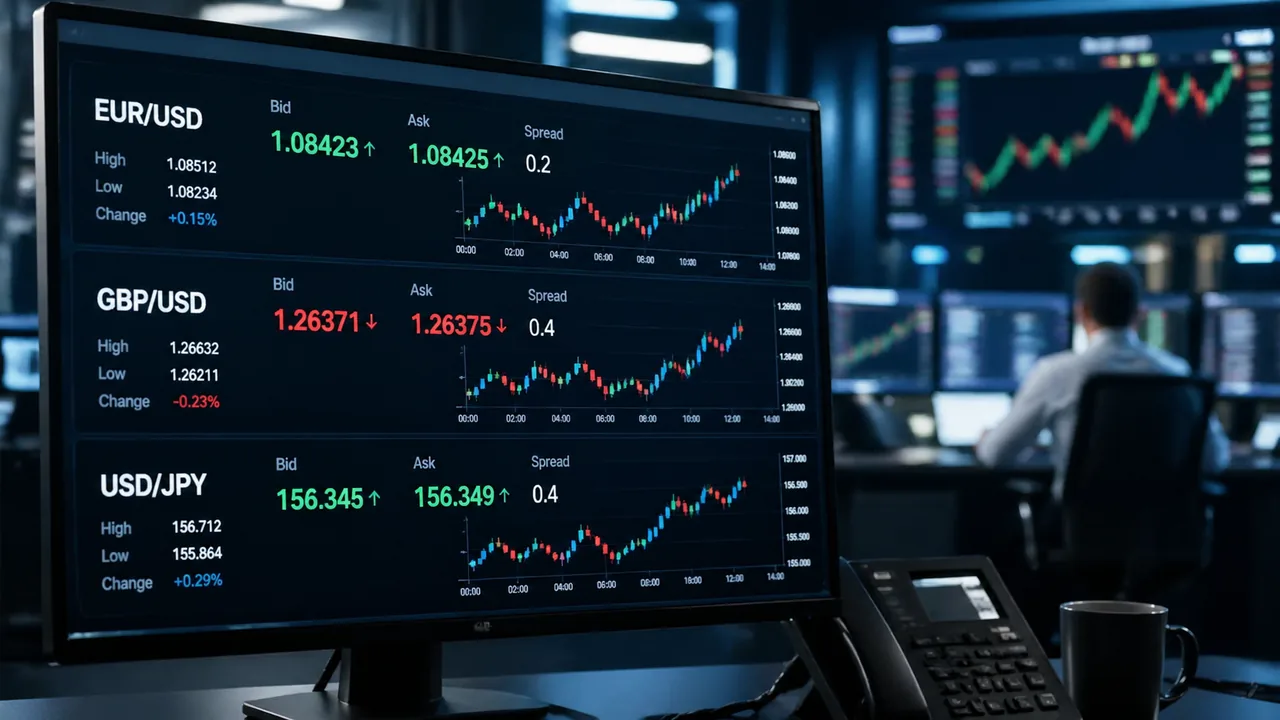
Each quote actually shows two prices: the bid (what the market will pay you if you sell) and the ask (what you pay if you buy). If EUR/USD shows 1.0848/1.0850, the spread is 2 pips. That gap is your immediate cost on entry. You start every trade slightly in the red by the width of the spread.
According to the BIS 2022 Triennial Survey, the forex market turns over roughly $7.5 trillion per day, which is why major pairs like EUR/USD can trade with spreads under half a pip at peak hours.
What are lots, pips, and leverage?
Forex uses standardised position sizing through lot sizes:
- Standard lot: 100,000 units of the base currency. On EUR/USD, one standard lot means you are buying or selling €100,000 worth of euros.
- Mini lot: 10,000 units. One tenth of a standard lot.
- Micro lot: 1,000 units. Used by beginners and those trading with smaller accounts.
A pip is the smallest standard price movement, typically the fourth decimal place for most pairs (0.0001). On EUR/USD, one pip on a standard lot is worth $10. On a mini lot it is $1, and on a micro lot it is $0.10.
Leverage lets you control a larger position with a smaller deposit. Under FCA rules, retail traders in the UK face maximum leverage of 30:1 on major forex pairs. That means a £1,000 deposit can control £30,000 of currency. A 1% move in the underlying therefore moves your equity by 30% — in either direction. Leverage is the primary reason retail forex accounts lose money at high rates.
What are the costs of trading forex?
Spread is the most visible cost, but it is not the only one. If you hold a position overnight, your broker applies a swap charge (or credit), which reflects the interest rate differential between the two currencies. These can add up significantly on longer trades.
Leverage is another factor that changes your cost profile. A 30:1 leverage ratio means a £1,000 deposit controls £30,000 of currency. That magnifies both gains and losses. Read more about how this works in the guide to leverage in trading, and see how broker fees accumulate in the spreads and commissions breakdown.
What are the practical first steps for a beginner?
Starting forex trading without preparation is one of the most reliable ways to lose money quickly. A structured approach significantly improves the chances of surviving long enough to learn from the market.
- Learn the mechanics first. Understand how pips, lots, leverage, and margin work before placing a single trade. This guide is a starting point; reading about currency pairs and central bank influences will round out the picture.
- Open a demo account. Every FCA-regulated broker offers paper trading with virtual funds. Use this to practice placing trades, managing stops, and understanding how positions behave during news events — without risking real money.
- Choose one or two pairs. EUR/USD and GBP/USD are the best starting pairs. Tightest spreads, deepest liquidity, most freely available analysis.
- Start with a micro lot account. When you move to live trading, micro lots keep losses manageable while you learn. A 50-pip loss on a micro lot is £5, not £500.
- Keep a trading journal. Recording why you entered and exited each trade, and the outcome, is one of the most effective ways to identify patterns in your decision-making.
- Use a broker regulated by the FCA. Check the FCA register before depositing. Regulated brokers must hold client funds in segregated accounts and provide negative balance protection.
Is forex trading right for you?
Regulatory disclosures across FCA-regulated brokers consistently show that over 70% of retail client accounts lose money when trading CFDs, including forex. That figure is not a scare tactic; it reflects the actual outcomes reported by regulated brokers.
Forex trading suits people who genuinely enjoy short-term market analysis, who have time to monitor open positions during active sessions, and who understand that leverage can wipe an account faster than it builds one. It is not a passive income source and it is not investing in the traditional sense.
If you prefer a less intensive approach, it is worth reading the comparison of investing vs trading before committing to either path. Many people discover that a mix of both makes more sense for their situation.
Related reading
- Currency pairs explained: majors, minors, and exotics
- How central bank decisions move currency markets
- Leverage in trading: how it amplifies both gains and losses
- Spreads and commissions: how broker costs affect your trading returns
- Investing vs trading: the key differences and which approach suits you
Frequently asked questions
What time does the forex market open?
The forex market opens Sunday at approximately 10pm UK time (when the Sydney session begins) and closes Friday at 10pm UK time. It runs continuously through the week, with liquidity peaking during the London session (8am–5pm UK time) and the London–New York overlap (1pm–5pm UK time). There is no single centralised exchange — it is a global, decentralised market operating across multiple time zones simultaneously.
What is a pip in forex?
A pip (percentage in point) is the standard unit of price movement for currency pairs. For most major pairs like EUR/USD, one pip equals 0.0001 — the fourth decimal place. On a standard lot (100,000 units), one pip is worth approximately $10. On a mini lot it is $1, on a micro lot it is $0.10. JPY pairs are the main exception: they are quoted to two decimal places, so one pip equals 0.01.
How much money do you need to start trading forex?
Technically, some brokers accept deposits as low as £100–500 and offer micro-lot trading, where each pip is worth around £0.10. In practice, that gives you almost no room for position sizing or drawdown. A more realistic starting point is £1,000–5,000, which allows you to size trades properly, survive a losing streak without blowing the account, and still have meaningful exposure to price moves. Never trade with money you cannot afford to lose.
Is forex trading taxed in the UK?
Yes, but the treatment depends on the product. CFD profits are subject to Capital Gains Tax in the UK. Spread betting profits, by contrast, are generally tax-free for UK residents because spread betting is classified as gambling under UK law. Tax rules change and depend on individual circumstances, so consulting a qualified tax adviser before trading is advisable.
Can I trade forex without leverage?
Yes. Most regulated brokers allow 1:1 leverage, meaning you control only what you deposit. The problem is that currency moves in major pairs are often measured in fractions of a percent per day, so without leverage, the capital required to generate meaningful returns is very large. That is why most retail traders use leverage, and also why losses can accumulate so fast when trades move against them.