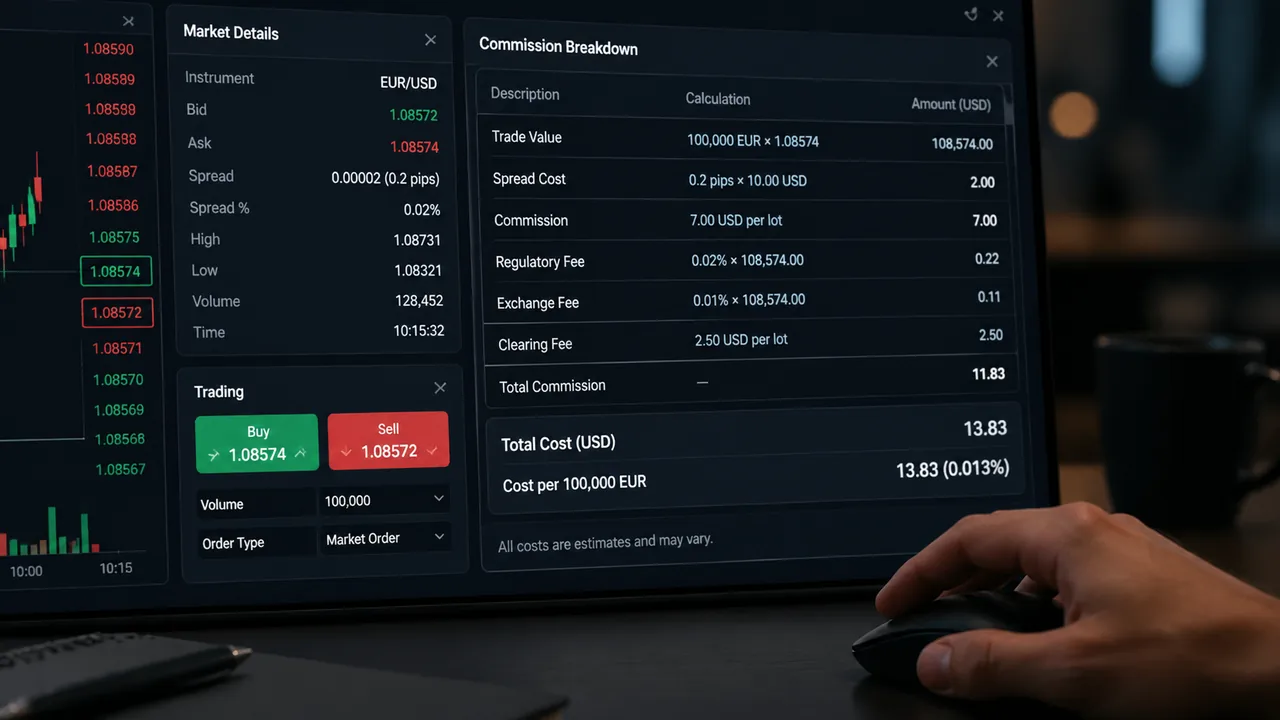
Every time you open and close a trade, your broker extracts a cost. For short-term traders making frequent trades, these costs can exceed the gains from a successful strategy. Understanding what you are paying and how to compare brokers on cost is a basic prerequisite for assessing whether a trading approach is viable.
The spread
The spread is the gap between the bid (sell) and ask (buy) price. If EUR/USD is quoted at 1.08500 / 1.08503, the spread is 0.3 pips. You pay the spread the moment you enter a trade: if you buy at 1.08503 and EUR/USD does not move, you could only sell at 1.08500, immediately down 0.3 pips.
Most retail forex and CFD brokers incorporate their profit into the spread rather than charging explicit commissions. “Zero commission” trading means the spread is wider than the interbank price; the broker’s profit is embedded in the quote.
Fixed vs variable spreads: when costs change and why
Spreads come in two forms, and each behaves differently depending on market conditions.
Fixed spreads remain constant regardless of market conditions. A broker offering a fixed 1.0 pip on EUR/USD will charge that same spread during the London open, during a Bank of England rate decision, and during the quiet Asian session. The advantage is predictability: you always know your entry cost. The disadvantage is that fixed spreads are generally wider than variable spreads during normal, liquid conditions — you pay a premium for that consistency.
Variable spreads reflect underlying market liquidity. During peak trading hours — the London/New York overlap between 13:00 and 17:00 GMT — EUR/USD spreads at competitive ECN brokers can reach 0.1 pips. But variable spreads widen significantly during low-liquidity periods (Asian session for European instruments, weekend open on Sunday), during major news announcements (non-farm payrolls, central bank rate decisions, CPI releases), and during periods of market stress. A spread that is 0.2 pips at 14:00 GMT can be 3 or 4 pips at 08:00 GMT or immediately after a surprise rate decision. If your strategy involves trading news events, variable spread costs must be factored into every trade calculation.
Commission-based pricing
Some brokers, particularly those offering ECN or STP execution, charge a separate commission per lot traded and quote raw interbank spreads. A broker charging $7 per standard lot round-turn with a 0.1 pip average spread is likely cheaper than a spread-only broker charging 1.5 pips, depending on trade size and frequency.
Commission structures vary by asset class. Forex pairs are most often traded on spread-only accounts, with ECN options available. Share CFDs are commonly commission-based, typically charged as a percentage of the trade value — 0.1% to 0.25% per side is common at UK-facing brokers. Index CFDs are usually spread-only. Commodity CFDs vary by broker but are frequently spread-only for the major contracts (gold, oil).
The breakeven point between spread-only and commission-based pricing depends on your average trade size. Larger positions favour commission-based pricing; micro-lot trading often makes spread-only pricing more economical because the minimum commission per trade represents a larger percentage of a small position.
How to calculate the total cost of a trade: a worked example
Understanding your all-in cost requires calculating every component together. Here is a worked example using a shares CFD trade.
You buy 100 CFDs on a UK share priced at £5.00. The total notional value of the position is £500. Your broker charges 0.1% commission each way. The spread on the share is 2 pence (the bid is £4.99, the ask is £5.01). You intend to hold for 3 days.
- Spread cost: 2p x 100 shares = £2.00 at entry (paid implicitly as the difference between the price you buy at and the midpoint)
- Commission at entry: 0.1% x £500 = £0.50
- Commission at exit: 0.1% x £500 = £0.50 (assuming price is unchanged for simplicity)
- Overnight financing: assume the broker charges the benchmark rate (4.5%) plus a 2.5% markup = 7% annual rate. Daily charge = 7% / 365 x £500 = approximately £0.096 per day. Over 3 days = £0.29
- Total round-trip cost: £2.00 + £0.50 + £0.50 + £0.29 = £3.29
For this trade to break even, the share must rise by at least £3.29 / 100 shares = 3.29 pence. That is the minimum move in your favour before you cover your costs. Expressed as a percentage of the position, your break-even threshold is 0.66% of the £500 position value — before making a single penny of profit.
This calculation assumes stable conditions. If the spread widens at entry or exit, or if you hold the position longer, costs increase accordingly. Understanding your per-trade cost upfront is part of sound position sizing and trade planning.
How overnight financing compounds: a 5-day vs 30-day comparison
Overnight financing (also called swap or rollover) is charged daily on any leveraged position held past the daily settlement time, typically 22:00 GMT. The charge accumulates each day you hold the position, and the compounding effect over weeks or months is often underestimated by traders who focus only on the spread.
Consider a CFD position on a UK index with a notional value of £10,000. The broker charges financing at 7% annually (benchmark rate plus markup), calculated on the full notional position value.
- Daily financing charge: 7% / 365 x £10,000 = £1.92 per day
- 5-day holding period: £1.92 x 5 = £9.60 in financing costs
- 30-day holding period: £1.92 x 30 = £57.60 in financing costs
On a 5-day hold, the financing cost is £9.60 — modest relative to a £10,000 position. On a 30-day hold, it grows to £57.60. Over a full year, the same position would cost £700.80 in financing alone, 7% of the full notional value. For a trader using leverage of 10:1, that means 7% of the notional is paid in financing on a position funded by only £1,000 of capital — a 70% annual drag on the capital actually deployed.
This is why CFD trading is designed primarily as a short-to-medium term instrument. Holding leveraged CFD positions for months or years creates financing costs that make it very difficult to generate net positive returns unless the underlying asset moves substantially in your favour. Investors with longer time horizons are generally better served by direct share ownership, ISA accounts, or funds, where no overnight financing applies.
How to compare brokers properly: calculate the all-in cost for your typical trade
Broker comparison sites typically headline the EUR/USD spread because it is the lowest number available and makes the broker look cheapest. This is almost never the relevant metric for your trading. To compare brokers properly, calculate the all-in round-trip cost for a trade that matches your actual strategy.
Start by identifying your typical trade: instrument, position size, expected holding time. Then for each broker you are comparing, calculate: spread cost at entry + spread cost at exit (or commission each way if applicable) + overnight financing for your expected holding period. Add any other applicable charges — currency conversion if the instrument is denominated in a currency other than your account currency, data fees, or minimum commission charges.
A broker quoting 0.0 pips on EUR/USD with a $7 round-trip commission is not necessarily cheaper than one quoting 0.8 pips with no commission. For a 0.1 standard lot trade (10,000 units), 0.8 pips costs $0.80. The $7 commission account is nearly nine times more expensive for a small trade. For a 2 standard lot trade (200,000 units), 0.8 pips costs $16. The commission account at $7 is substantially cheaper. The breakeven trade size where cost equality occurs is approximately 0.875 standard lots. Know your trade sizes before choosing an account type.
Break-even analysis: how many pips must a trade move before you profit?
The break-even move required before a trade becomes profitable is directly determined by your total entry cost. For a standard lot forex trade (100,000 units), each pip is worth $10. If your total entry cost (spread plus commission) is $15, the market must move 1.5 pips in your favour before you break even at exit. Any profit target below 1.5 pips is a guaranteed loss on that trade regardless of direction.
This number matters most for scalpers and short-term traders whose profit targets are measured in single-digit pips. A strategy targeting 5 pips with a $15 entry cost means 30% of the potential profit disappears immediately to costs — before accounting for slippage or exit spread. Knowing your break-even requirement before placing any trade forces realistic profit target setting and highlights which strategies are viable at a given broker’s cost structure.
Hidden costs to watch for
- Inactivity fees: some brokers charge monthly fees if no trades are placed within a specified period.
- Withdrawal fees: card or wire withdrawal charges vary by method and can add up across multiple withdrawals.
- Currency conversion fees: if your account currency differs from the instrument’s denomination, each trade incurs a conversion cost.
- Data fees: some platforms charge for real-time quotes on certain exchanges, particularly for share trading.
The true cost of trading at any broker is the sum of all these elements, not just the headline spread. Running a cost comparison using your typical trade size and holding period across two or three brokers before committing is time well spent. For broker selection considerations beyond cost, see the guide to what to check before depositing with a broker.
Related reading
- How to choose a trading broker: the checks that matter before depositing
- Broker regulation: what the licence types mean and which regulators matter
- Demo accounts: what they simulate and what they do not
- Position sizing: how to calculate the right trade size
- CFD trading strategies: the main approaches explained
Frequently asked questions
Are commission-free brokers really free?
No. Commission-free brokers embed their revenue in the spread, which is wider than the raw interbank price. The cost is real; it is just presented differently. For active traders, the total round-trip cost of a commission-free account is often higher than a commission-based account with tight raw spreads. Always calculate the full round-trip cost — spread plus any commission — rather than focusing on either element in isolation.
What is overnight financing and how is it calculated?
Overnight financing (also called swap or rollover) is a daily charge applied to any leveraged position held past the broker’s daily cutoff, typically 22:00 GMT. The charge reflects the cost of borrowing the capital to hold the leveraged position and is calculated based on the full notional value of the position, the relevant benchmark interest rate (such as SONIA in the UK), and a broker markup. Positions held for multiple days accumulate this charge daily. Most brokers publish their specific swap rates in the platform’s contract specifications for each instrument.
How do I compare broker costs effectively?
Define your typical trade: instrument, position size, and expected holding period. For each broker, calculate the total round-trip cost including spread at entry, spread at exit (or commission each way), overnight financing for your expected hold time, and any additional fees such as currency conversion or data charges. Use this single all-in number for comparison, not the headline spread alone. For a detailed worked example, see the section above on calculating total trade cost.
Do I pay a spread when closing a trade?
Yes. The bid-ask spread applies whenever you transact, both at entry and at exit. When you close a position, you are trading at the current market price, which again carries a spread. The full round-trip cost is typically quoted as a single number (entry plus exit combined), but it is paid in two parts: once when you open and once when you close. For a full picture of how these costs fit into the broker selection process, see the guide to what to check before depositing with a broker.