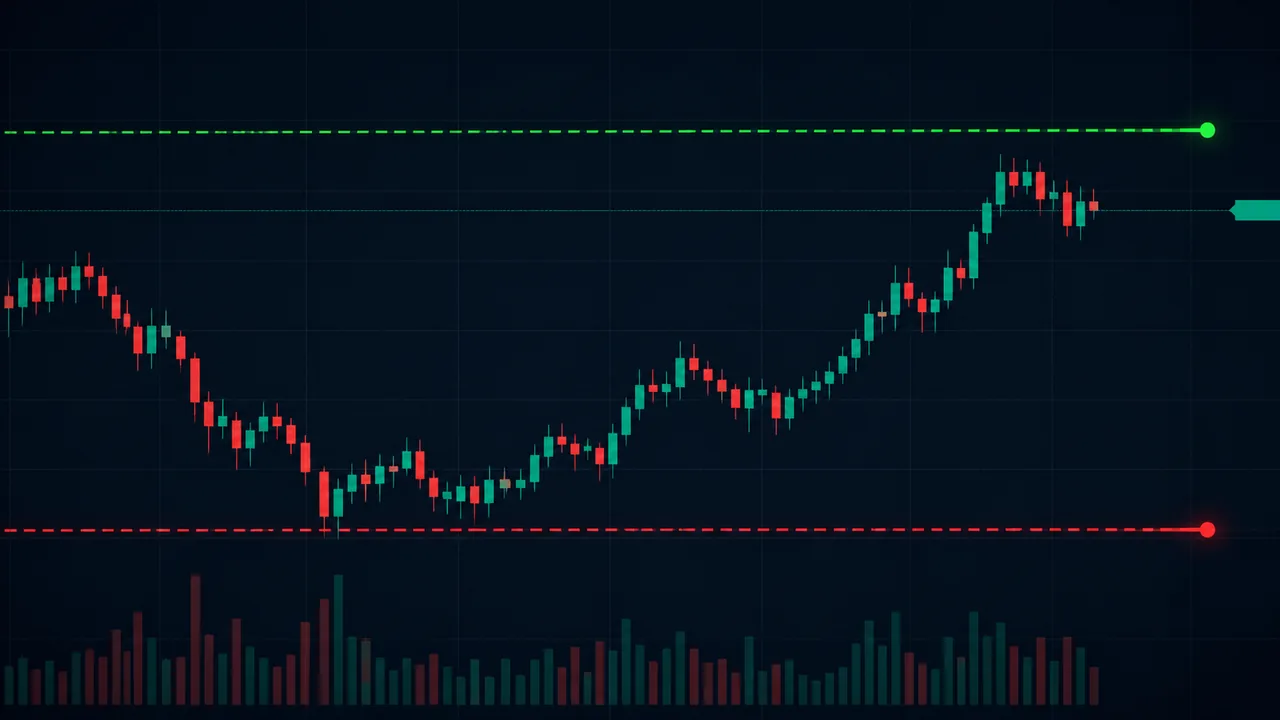
A stop-loss order closes your position automatically when the price reaches a level you have defined in advance. It is the most direct tool for limiting losses on a trade. How you place it, how wide it is, and how you respond to it affects your trading results as much as entry timing.
What are the different types of stop-loss order?
Not all stop-loss orders work in the same way. Understanding the distinctions matters because the type you choose affects both your execution risk and your cost.
Hard stop (standard stop-loss order). This is the most common type. You set a price level with your broker; when the market reaches that level, your stop converts to a market order and executes at the best available price. Execution is fast, but you are not guaranteed to exit at the exact stop price — particularly in fast-moving or illiquid conditions.
Mental stop. Some traders use a “mental stop” — an intention to close the position manually if price reaches a certain level rather than placing a formal stop order with the broker. This relies entirely on self-discipline. When a position is moving against you and real money is at stake, the psychological pressure to delay that decision is substantial. Mental stops work for a small minority of traders with years of experience and strict discipline; for most, they result in losses that are significantly larger than planned.
Trailing stop. A trailing stop moves in the direction of a profitable trade, locking in gains as the position moves in your favour, while stopping it from reversing too far. You set a trailing distance — either a fixed number of points/pips or a percentage — and the stop adjusts automatically as price moves. If price reverses by the trailing amount, the stop triggers. Trailing stops are useful for protecting profits on trending positions without requiring you to manually move the stop.
Guaranteed stop-loss order (GSLO). A guaranteed stop-loss order executes at exactly the specified price regardless of gaps, slippage, or extreme volatility. The broker absorbs the gap risk rather than passing it to the trader. GSLOs are available through some FCA-regulated brokers and carry a premium — usually a small additional spread charge when the stop is triggered, or a fee charged upfront. They are particularly valuable when holding positions through high-impact scheduled events such as central bank rate decisions or company earnings announcements.
Where should you place your stop-loss?
The stop should sit at a price level where your trade thesis is clearly wrong. For a long position, this is typically below a recent swing low or a key support level. For a short, above a recent swing high or resistance level. The logic is that if price reaches that level, the market is telling you something about the trade direction that your original analysis did not anticipate.
Placing a stop at an arbitrary distance (“I always use 20 pips”) without reference to market structure is less effective than stops grounded in chart levels, because arbitrary stops are more likely to be triggered by normal price noise before the trade has had time to develop.
Three practical approaches to stop placement:
- Structure-based: Place the stop just below the most recent swing low (for longs) or just above the most recent swing high (for shorts). If price breaks through that structural level, the pattern supporting your entry is invalidated.
- ATR-based: The Average True Range (ATR) measures how much an asset typically moves in a given period. Setting a stop at 1× to 1.5× ATR below entry calibrates the stop to the instrument’s actual volatility. A stock with an ATR of £0.50 needs at least a £0.50–£0.75 stop to avoid being triggered by routine daily noise.
- Percentage-based: Setting the stop at a fixed percentage below entry (for example, 2% below entry price) is simple and consistent, though it ignores market structure entirely. It is better than an arbitrary pip/point distance because it scales with the asset price, but less precise than the structure or ATR approaches.
What is slippage and when does it occur?
Slippage is the difference between your stop price and the actual execution price. When markets move fast, or when gaps occur over weekends, your stop order becomes a market order at the stop price but executes at whatever price is next available — which can be significantly worse.
During most normal trading sessions on major currency pairs or large-cap stocks, slippage on stop orders is minimal — often one or two pips or pence. The conditions that produce material slippage are:
- News events: Major economic releases (UK CPI, Bank of England rate decisions, US non-farm payrolls) can move markets several percent in seconds. Stops placed around these events frequently execute several pips or points away from the stated level.
- Weekend gaps: Markets close on Friday evening and reopen Sunday evening (forex) or Monday morning (equities). If significant news emerges over the weekend, the market can open far from where it closed. Your stop order will execute at the open price, not your specified stop level. A 50-pip stop on EUR/USD held through a weekend where a major political event occurs could execute 100+ pips away from your stop.
- Low liquidity periods: Thin liquidity in the early hours of the Asian session, or immediately after market open, can mean fewer market participants are willing to take the other side of your order at prices near your stop.
Guaranteed stop-loss orders eliminate slippage risk entirely by contractually guaranteeing execution at the specified price, at the cost of the premium charge when triggered.
What is stop-hunting and how do you avoid it?
Stop-hunting refers to price movement that appears designed to trigger concentrated stop-loss orders before reversing. This happens because retail traders tend to place stops at predictable, obvious levels — just below round numbers, just below recent lows, or at commonly taught technical distances.
When large concentrations of stops cluster at the same price level, any participant with enough size to push price to that level can trigger those stops, collect the liquidity from the resulting market orders, and then allow the price to reverse. This behaviour is most observable around round numbers (1.3000, 1.2500) and widely watched technical levels.
The practical defence is to avoid placing stops exactly at obvious levels. Instead of a stop at exactly £100.00, place it at £99.60 — beneath the round number and beyond where a brief intraday wick might reach. Similarly, rather than placing a stop exactly at the most recent swing low, place it a few points below that level, in the “messier” zone that is less obviously targeted.
Why do traders resist using stop-loss orders?
Despite the well-documented costs of not using stops, a significant proportion of retail traders resist placing them consistently. The psychology behind this resistance is worth understanding because it is one of the main drivers of the large losses that characterise undisciplined trading.
The core issue is that placing a stop converts a potential loss from abstract to concrete. Before a stop is hit, a losing position can be rationalised as “temporarily down.” Once the stop triggers, the loss is real. Many traders subconsciously avoid this outcome by not placing stops at all, or by moving them further away when price approaches them — a behaviour known as “moving the goalposts.”
The result is almost always a larger loss than the original stop would have produced. A trader who starts with a plan to risk £100 on a trade and then moves the stop when that £100 level is approached — “just to give it a bit more room” — may end up losing £300, £500, or more on the same trade. This pattern, repeated across multiple trades, produces the catastrophic drawdowns that end most retail trading accounts.
Case study: how a poorly placed stop turns a small loss into a large one
Consider this scenario: a trader buys 500 shares of a UK mid-cap stock at £4.00 per share, intending to risk £200 on the trade (1% of a £20,000 account). The plan calls for a stop at £3.60 — £0.40 below entry — which would produce a £200 loss if triggered.
The stock falls to £3.70 two days after entry. The trader does not place the stop, reasoning that the position is “only slightly down” and the thesis is still intact. Over the following week, the stock falls to £3.40. Now the unrealised loss is £300 — 50% larger than planned. The trader reasons that £3.40 is a support level and holds.
The stock gaps down on a profit warning to £2.80. The unrealised loss is now £600 — three times the original plan. The trader finally closes the position. What was planned as a £200 maximum loss became £600 — solely because no stop was placed and the position was allowed to run far beyond the level where the original thesis was invalidated.
This type of outcome is not unusual. It is the predictable result of removing the mechanical decision point that a stop order provides.
Stop placement by timeframe
The timeframe you trade determines the appropriate stop distance. Day traders working from 5-minute charts can often place stops within a few pips of a key intraday level, because price does not typically move far from recent structure within a single session. Swing traders using daily charts need wider stops, often 30 to 100+ pips, because daily candle ranges are naturally larger and a tighter stop will be triggered by routine market movement that has nothing to do with the trade thesis being wrong.
Matching stop distance to timeframe is not a minor technical point. A stop placed on a daily chart signal but sized for a 5-minute chart will almost always be triggered before the trade has time to develop. Position sizing adjusts the number of units you trade so that a wider stop on a higher timeframe does not automatically mean more pound risk — the two tools work together.
Related Reading
- Position sizing: how to calculate the right trade size for your account
- Risk-reward ratios: what they mean and how to use them before entering a trade
- Leverage in trading: how it amplifies both gains and losses
- Margin call: what it is and how to avoid one
- Trading psychology: how fear and greed affect decisions and what to do about it
- CFDs explained: how contracts for difference work and what makes them risky
Frequently asked questions
Should I always use a stop-loss order?
Yes. The only narrow exception some professional traders apply is for extremely short-term positions held for a few seconds or minutes with immediate constant monitoring and a clear mental exit discipline built over years of practice. For any position that will be left unattended, even briefly, an active stop order is not optional. The cost of one unprotected position going wrong can easily exceed months of gains. The case study above illustrates how quickly a “minor” unprotected loss can become a major one.
What is a guaranteed stop-loss order?
A guaranteed stop-loss order (GSLO) is a special order type offered by some FCA-regulated brokers that executes at exactly the price you specify, regardless of gaps or slippage. Unlike a standard stop-loss order, which becomes a market order when triggered and may execute at a worse price, a GSLO contractually binds the broker to execute at your specified level. The cost is a premium — typically charged as an additional spread on the trade when the stop is triggered, or as a small upfront fee. GSLOs are most valuable when holding positions over major economic announcements or weekends when gap risk is highest.
Does a stop-loss guarantee I won’t lose more than a planned amount?
A standard stop-loss order does not guarantee exact execution. It becomes a market order when triggered, which means execution at the next available price. In most conditions on liquid markets, that price is very close to the stop level. In extreme events — a flash crash, a major economic announcement, or a market open after significant news over a weekend — gaps can be substantial. Leverage amplifies the impact of these gaps. Guaranteed stop-loss orders remove gap risk; standard stop-loss orders reduce it significantly but do not eliminate it entirely.
What is a trailing stop and when should I use it?
A trailing stop moves in the direction of profit as the trade develops, locking in gains while allowing the position to continue running. If you enter a long at £100 with a trailing stop set 10 points below the current price, and the price moves to £115, the trailing stop rises to £105. Use trailing stops when a trade has moved significantly in your favour and you want to protect those gains without manually moving the stop or closing the position. The trade-off is that trailing stops frequently close positions before the final push higher, capturing most but not all of a move.