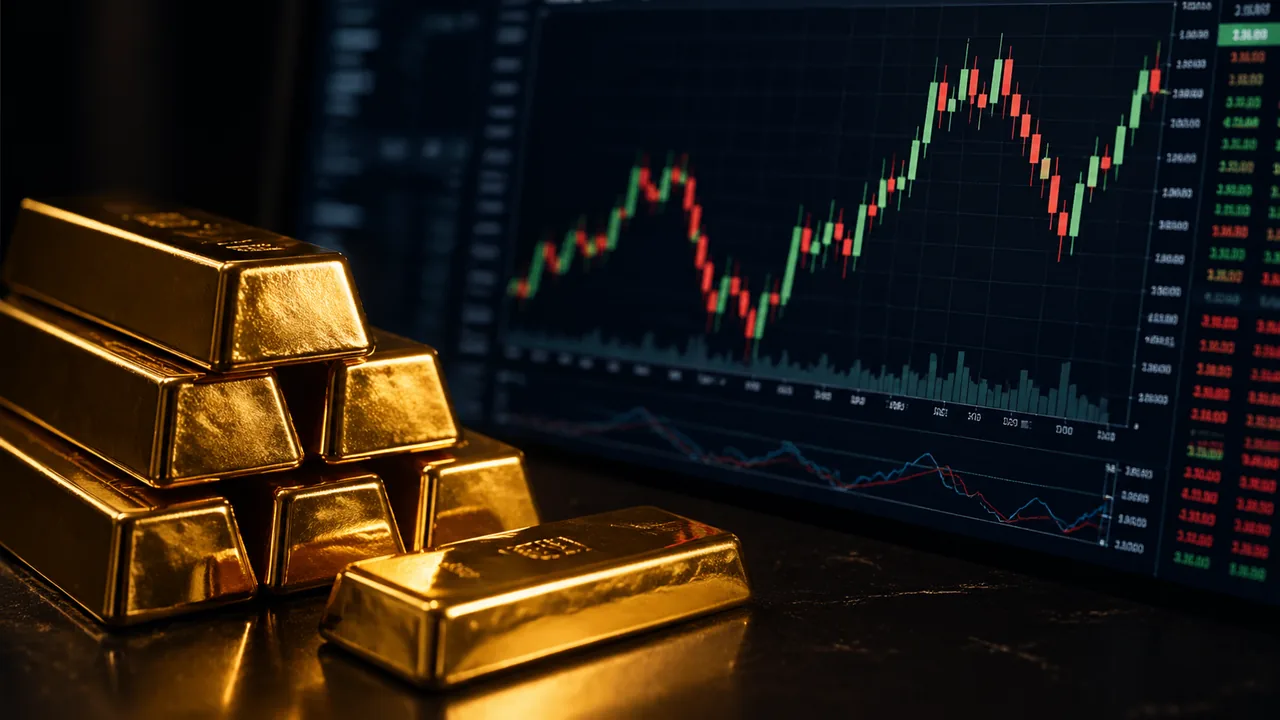
XAU/USD is the ticker symbol for gold priced in US dollars. XAU comes from the ISO 4217 code for gold (Au is the chemical symbol, from the Latin aurum). Trading XAU/USD means speculating on the price of one troy ounce of gold against the dollar, using the same platforms and instruments used for forex trading. In 2025, average daily gold trading volume reached approximately $361 billion (World Gold Council), making it one of the most liquid instruments available to retail traders. This guide explains why gold is quoted this way, what makes the gold market unique, how to trade it effectively, and how it compares to other gold investment vehicles.
Why is gold quoted as XAU/USD rather than just a commodity price?
Calling gold a currency pair rather than simply a commodity price has more than semantic significance. The XAU/USD convention positions gold explicitly as a monetary asset — something that competes with fiat currencies as a store of value — rather than as an industrial raw material like copper or crude oil. This distinction shapes how gold is traded and analysed.
Commodity markets typically focus on supply and demand fundamentals: mine output, industrial consumption, inventory levels. Gold has these factors too, but they are largely secondary to monetary demand — investment flows, central bank reserves, and the desire to hold an asset outside the banking system. Treating gold as a currency pair recognises that its price moves primarily in response to dollar strength, real interest rates, and monetary conditions rather than physical supply constraints.
Practically, the XAU/USD notation also means gold quotes two decimal places and is priced in US dollars per troy ounce — just as EUR/USD quotes the euro price in US dollar terms. This makes gold directly comparable to dollar-denominated assets on the same trading platform, facilitating analysis of correlations and hedges that would be harder to see if gold were listed on a separate commodities feed.
What makes the gold market unique?
Several structural features distinguish the gold market from most other financial instruments available to retail traders.
24/5 trading: XAU/USD trades around the clock on weekdays, from the Sydney open on Monday morning through to the New York close on Friday evening (UK time). There is no single centralised exchange — gold trades over-the-counter (OTC) through a global network of banks, dealers, and electronic platforms. This means liquidity and spreads vary significantly depending on which geographic session is active.
London dominance and the LBMA fix: The London Bullion Market Association (LBMA) is the centre of the global physical gold market. The LBMA Gold Price — known informally as the London fix — is set twice daily at 10:30am and 3:00pm London time and is used as a benchmark for physical gold transactions worldwide, from mining companies to central banks. The 3:00pm fix often coincides with increased activity and tighter spreads in XAU/USD as institutional participants benchmark their positions to the fix price.
COMEX futures: The most actively traded gold futures contract is listed on COMEX (part of CME Group) in New York. COMEX gold futures (ticker: GC) represent 100 troy ounces of gold and trade in months with active contracts typically extending one to two years forward. COMEX volume data and open interest figures are widely watched as indicators of market positioning and sentiment.
OTC dominance: Despite the significance of COMEX, the majority of gold trading volume occurs OTC. Most retail CFD trading of gold is priced off the OTC spot market rather than directly off COMEX futures, though the two prices are closely aligned and arbitrage keeps them in line.
What moves the XAU/USD price?
US real interest rates: The single strongest fundamental driver. Real yields are nominal interest rates minus inflation expectations (typically measured using TIPS — Treasury Inflation-Protected Securities). When real yields fall, the opportunity cost of holding gold — which pays no interest — decreases, making gold relatively more attractive. When the Federal Reserve raised rates aggressively in 2022-2023, gold traded largely sideways despite high inflation. As rate cut expectations grew in 2024, gold surged to all-time highs above $2,700 per ounce.
US dollar strength (DXY): Gold is priced in dollars, so a stronger dollar generally makes gold more expensive for foreign buyers, reducing demand and pushing the dollar price down. The correlation between gold and the dollar index is typically negative but not perfectly consistent — during severe risk-off events, both the dollar and gold can rise simultaneously as safe-haven demand overrides the mechanical relationship.
Geopolitical risk and risk sentiment: Gold often rallies during genuine risk-off episodes — geopolitical shocks, banking crises, or sudden uncertainty about the financial system. The relationship is not reliable for short-term market selloffs (gold also fell sharply in the initial March 2020 COVID crash as investors sold everything to raise cash) but holds over medium-term stress periods. Gold’s role as a monetary asset without counterparty risk becomes particularly valued when confidence in financial institutions wavers.
Central bank buying: Central banks in China, India, Russia, Poland, and Turkey have been large net buyers since 2022, providing structural demand support that is relatively price-insensitive. The World Gold Council reported central bank purchases of over 1,000 tonnes per year in both 2022 and 2023. This structural buying shifted gold’s demand floor upward and contributed significantly to the 2024-2025 bull run.
What is the gold-dollar correlation and why does it usually hold?
The negative correlation between gold and the US dollar is one of the most consistent relationships in global financial markets. The mechanical explanation is straightforward: when the dollar rises against other currencies, the price of gold in those other currencies rises too, which dampens demand from non-dollar buyers. When the dollar weakens, gold becomes cheaper for buyers using euros, yen, or pounds, stimulating demand.
The deeper reason is that gold and the dollar are competing stores of value in the global monetary system. A strong dollar signals confidence in US economic management and monetary stability. A weak dollar, particularly one accompanied by high US inflation or fiscal deficits, tends to drive investors toward hard assets including gold as an alternative store of value.
Monitoring the DXY (US Dollar Index) alongside XAU/USD helps traders identify whether a gold move is driven by gold-specific demand or simply by dollar weakness. If gold is rising and DXY is falling in line with the expected negative correlation, the move is more likely to reflect fundamental momentum. If gold and the dollar are both rising simultaneously, something unusual is happening — typically a flight to safety that overwhelms the mechanical relationship.
How to trade gold: CFDs, futures, and ETFs compared
There are several distinct ways to get exposure to gold prices, and they serve different purposes depending on your holding period, account size, and objectives.
| Instrument | Best for | Leverage available | Overnight costs | UK tax treatment |
|---|---|---|---|---|
| XAU/USD CFD | Short-term trading (hours to days) | Up to 20:1 (retail, ESMA rules) | Swap charges apply | Capital gains (or spread bet: tax-free) |
| Gold futures (COMEX GC) | Active traders and institutional hedgers | High (exchange-set margins) | Rollover cost on expiry | Capital gains |
| Gold ETF (e.g. iShares Physical Gold) | Long-term investors | None (no leverage) | Annual management fee (typically 0.15–0.25%) | CGT; can hold in ISA/SIPP |
| Physical gold (coins/bars) | Long-term storage of value | None | Storage and insurance costs | CGT (gold bullion coins may be exempt) |
For short-term traders, XAU/USD as a CFD or spread bet is the most practical tool. For investors holding gold as part of a longer-term portfolio allocation, a gold ETF — such as iShares Physical Gold (SGLN) or Invesco Physical Gold (SGLP), both listed on the London Stock Exchange — is typically more appropriate than a leveraged CFD position. Physical gold ETFs hold allocated gold bars and provide direct economic exposure without counterparty risk from a leveraged product.
Lot sizes and pip values for XAU/USD explained
Understanding the contract mechanics of gold CFDs is essential before committing real money. Gold quotes prices to two decimal places. A price of 2,345.50 means $2,345.50 per troy ounce. The smallest price movement is $0.01 (one cent), which is the pip equivalent for this instrument.
A standard lot in XAU/USD is 100 troy ounces. On a standard lot, a $1.00 move in gold price equals $100 profit or loss. A $25 move — well within gold’s typical daily range — produces $2,500 of price movement on a single standard lot. This is why standard lots are entirely inappropriate for most retail traders.
Most retail CFD brokers offer smaller contract sizes. A mini contract (10 oz) gives $10 per dollar move; a micro contract (1 oz) gives $1 per dollar move. Some brokers allow fractional sizing. The appropriate contract size depends on your account balance, your stop-loss distance, and your maximum acceptable loss per trade. A trader with a £2,000 account risking 1% per trade (£20) and using a $20 stop-loss would need a 1 oz micro contract to keep the loss at approximately £20. The same trader on a mini contract with the same stop would risk £200 — 10% of the account — on a single trade. See our guide on position sizing for the full calculation method.
Seasonality patterns in gold
Gold exhibits some seasonal tendencies that are worth knowing, though they are tendencies rather than reliable trading signals. Historically, gold has shown relative strength in January (as investors return to markets and rebalance toward safe-haven assets after the year-end), in August and September (partly driven by Indian jewellery demand ahead of the wedding and festival season), and around Chinese New Year (typically January to February).
Gold has historically tended to be weaker in the spring and early summer months. These seasonal patterns are based on long-run averages and can be overridden entirely by macro factors — real interest rate movements, dollar trends, and geopolitical events dwarf seasonal influences in most years. Use seasonal tendencies as background context, not as a primary trading signal.
Key support and resistance methodology for gold charts
Gold responds well to traditional technical analysis, partly because it is widely followed and many participants make decisions based on the same chart levels. Key levels to watch include:
Round numbers: Psychological price levels such as $2,000, $2,500, $3,000, and $3,500 consistently act as support or resistance because large numbers of traders and institutions cluster orders around them. Breaks of these levels, when sustained on a daily close basis, tend to produce accelerated moves in the direction of the break.
All-time highs and prior swing highs: Gold’s break above $2,100 in late 2023, which had previously capped multiple rallies, triggered a sustained acceleration to $2,700 in 2024. Once a prior high is broken convincingly, it typically becomes support on any subsequent retest.
Moving averages: The 50-day and 200-day moving averages are widely used on gold daily charts. The 200-day MA in particular is watched by institutional participants as a long-term trend indicator. Gold trading above its 200-day MA in a rising trend is a bullish structural condition; trading below it is a warning sign.
Common mistakes when trading XAU/USD
Several specific mistakes are common among traders who move from forex into gold without adjusting their approach.
The first is applying forex pip-based stop thinking. In forex, a 20-pip stop on EUR/USD represents roughly $200 on a standard lot. In gold, a “20-pip” mental model simply does not transfer — gold moves in dollars per ounce, and a $20 stop on gold at $2,500 is only a 0.8% stop, which is actually tight given gold’s daily volatility of $15-40 per ounce.
The second mistake is ignoring real yield context. Gold’s price is closely linked to US 10-year real yields (nominal Treasury yields minus inflation expectations, tracked on TradingView as US10Y minus INFLATION). A sharp fall in real yields often precedes or accompanies a gold rally. Trading gold without watching real yields is trading with a key variable unmonitored.
The third mistake is oversizing positions relative to gold’s volatility. On a standard contract (100 oz), a $30 move — less than gold’s average daily range — produces $3,000 of price change. Micro contracts (1 oz) are genuinely appropriate for smaller accounts, not a mark of timidity.
Related reading
- Gold trading strategies: trend following, breakout, and range trading
- Position sizing: how to calculate the right trade size for your account
- Volatility: what it is, how it is measured, and why it matters
- Stop-loss orders: where to place them and the trade-offs involved
- Leverage in trading: how it amplifies both gains and losses
Frequently asked questions
What time of day is best for trading XAU/USD?
The London open at 8am UK time and the New York open at 2:30pm UK time are the two highest-volume windows for XAU/USD. Spreads are tightest during these periods and price moves are more decisive. The overlap between London and New York (roughly 1pm–5pm UK time, or BST in summer, GMT in winter) is often the most active window of the trading day. The LBMA 3pm fix also falls in this window. The Asian session tends to see slower, choppier price action in gold with wider spreads.
Why does gold usually rise when the US dollar falls?
The negative correlation exists because gold is priced in dollars — when the dollar weakens, it takes more dollars to buy the same ounce, mechanically lifting the dollar gold price. Beyond the mechanical effect, gold and the dollar compete as safe-haven assets. Dollar weakness often reflects declining confidence in US monetary conditions, which drives demand toward hard assets like gold. The relationship is a general tendency rather than a law and breaks down when both assets attract safe-haven demand simultaneously, as can happen in acute financial crises.
Can I buy actual physical gold through a CFD broker?
No. Trading XAU/USD as a CFD or spread bet gives you price exposure to gold without any ownership of physical metal. A CFD is a contract between you and the broker — there is no gold bar behind it. If you want actual gold ownership, you need to buy physical gold coins or bars directly, or invest in a physically-backed gold ETF such as iShares Physical Gold (SGLN) or Royal Mint Responsibly Sourced Physical Gold (RMAU), both of which hold allocated gold on investors’ behalf.
What is the minimum deposit needed to trade gold?
With a micro contract (1 oz) at 20:1 leverage and a gold price of around $2,500, the margin requirement is approximately $125 per ounce. Many brokers allow fractional positions, so the practical minimum for a small gold trade can be as low as $50–200 depending on the broker’s minimum lot size and leverage offered. That said, trading at the absolute minimum leaves almost no room for drawdown management. A more functional starting balance for gold trading is £500–1,000, allowing meaningful application of position-sizing discipline without excessive concentration of risk on a single trade.