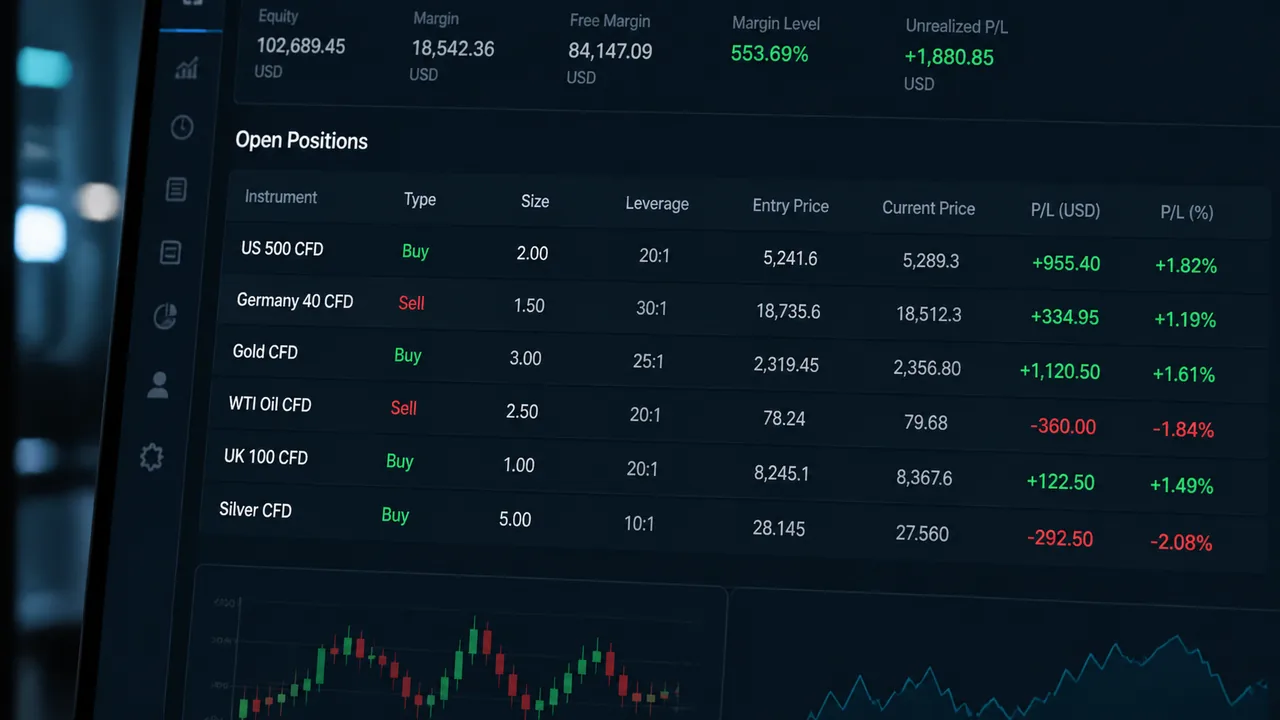
CFD trading means speculating on the price movement of an asset through a contract for difference, without ever owning the asset itself. CFDs are derivatives used widely across UK, European, and Asian retail markets, though they are banned for retail traders in the United States. Understanding how they work explains both their appeal and why most retail CFD accounts lose money.
What is the basic structure of a CFD?
When you open a CFD position, you enter a contract with your broker to exchange the difference in the price of an asset between when you open and when you close the trade. If you buy (go long) a CFD on a stock at 100p and it rises to 120p, you receive the difference (20p per share equivalent). If it falls to 80p, you pay the difference.
Because you do not own the underlying shares, there is no settlement, no stamp duty on UK equity CFDs, and you can go short as easily as long.
How does a CFD profit and loss calculation work?
Here is a worked example using a CFD on Barclays shares:
- You open a long CFD on Barclays at 200p per share
- You take 5,000 contracts (equivalent to 5,000 shares)
- Total position value: 5,000 × 200p = £10,000
- With 10:1 leverage (10% margin), you deposit £1,000 as margin
Scenario A — trade goes in your favour: Barclays rises to 220p. You close the position.
- Profit: (220p – 200p) × 5,000 = £1,000
- Return on margin deposited: 100% on your £1,000 margin
- Return on underlying move: 10% (the share rose 10%)
Scenario B — trade goes against you: Barclays falls to 180p. You close the position.
- Loss: (200p – 180p) × 5,000 = £1,000
- You lose your entire £1,000 margin on a 10% adverse move
This illustrates the core dynamic of leverage: it amplifies both gains and losses by the leverage ratio. A 10% move in the underlying becomes a 100% move on your deposited margin.
What are overnight swap charges and how do they add up?
If you hold a CFD position overnight, your broker applies a daily financing charge — often called a swap or overnight funding fee. This reflects the cost of the leverage you are using, based on a benchmark interest rate (such as SONIA in the UK, or SOFR in the US) plus a broker margin, typically 2–3%.
Here is a concrete example of how these charges accumulate:
- You hold a long CFD on the FTSE 100 index with a position value of £20,000
- The financing rate is benchmark rate (5%) + broker margin (2.5%) = 7.5% per year
- Daily charge: £20,000 × 7.5% ÷ 365 = approximately £4.11 per day
- Held for 5 days: 5 × £4.11 = £20.55 in financing charges
- Held for 30 days: £123.30 in financing charges
- Held for 1 year: approximately £1,500 in financing charges — 7.5% of the full position value
For short-term trades held for hours or a day or two, financing charges are negligible. For positions held for weeks or months, they become a meaningful drag on returns. This is one of the primary reasons CFDs are not suitable as long-term investment vehicles.
How does CFD trading compare to buying shares directly?
| Feature | CFD trading | Buying shares directly |
|---|---|---|
| Ownership of shares | No — you hold a contract | Yes — you own the shares |
| Stamp Duty (UK) | No stamp duty on CFDs | 0.5% on UK share purchases |
| Dividends | Dividend adjustment credited/debited (not a real dividend) | Full dividend paid as shareholder |
| Leverage | Up to 20:1 on major indices, 10:1 on equities (retail) | None (unless you use a margin account) |
| Overnight financing | Charged daily on open positions | None |
| Short selling | Easy — just open a sell position | Complex — requires borrowing shares |
| Tax treatment (UK) | Capital Gains Tax on profits | CGT on gains; income tax on dividends above allowance |
| ISA eligibility | Not eligible | Eligible for Stocks and Shares ISA |
| Voting rights | None | Yes, as a registered shareholder |
| Best suited to | Short-term speculation, hedging | Long-term investment, income |
What assets can be traded as CFDs?
CFDs are available on a wide range of underlying assets, covering most of the major financial markets:
- Shares (equities): CFDs on individual company shares, including FTSE 100 stocks, US listed shares, European equities, and more. You gain exposure to the share price without owning the stock.
- Stock market indices: CFDs on the S&P 500, FTSE 100, DAX, Nikkei 225, and other major indices. These let you trade the overall direction of a market rather than picking individual stocks.
- Forex (currency pairs): The most popular CFD market by volume. Major, minor, and exotic currency pairs are available through most CFD brokers.
- Commodities: Oil (Brent and WTI), gold, silver, natural gas, copper, and agricultural commodities like wheat and corn. Commodity CFDs give access to markets that would otherwise require futures accounts.
- Cryptocurrencies: Bitcoin, Ethereum, and other major cryptocurrencies are available as CFDs through regulated UK brokers, though with the lowest leverage limits (2:1 for retail clients).
- Government bonds (treasuries): CFDs on UK gilts, US Treasuries, German Bunds, and other sovereign debt instruments.
What leverage limits apply to UK retail traders?
Under ESMA rules adopted by the FCA, retail CFD traders in the UK face maximum leverage limits that vary by asset class. These limits were introduced in 2018 to protect retail traders from excessive leverage-related losses:
| Asset class | Maximum leverage (retail) | Margin required |
|---|---|---|
| Major forex pairs | 30:1 | 3.33% |
| Minor/exotic forex pairs | 20:1 | 5% |
| Major equity indices | 20:1 | 5% |
| Minor equity indices & gold | 10:1 | 10% |
| Individual equities | 5:1 | 20% |
| Other commodities | 10:1 | 10% |
| Cryptocurrencies | 2:1 | 50% |
Professional clients — those who meet specific criteria around trading experience, portfolio size, and financial industry knowledge — can apply for higher leverage limits. They also lose negative balance protection and some other regulatory safeguards. Most retail traders are better served by retail account status.
How do you open and close a CFD position step by step?
- Choose your broker. Verify FCA authorisation on the FCA register. Check the broker’s published loss rate disclosure.
- Open and fund your account. Complete identity verification (KYC) and deposit funds. Most UK brokers accept bank transfer, debit card, and sometimes PayPal.
- Find the market. Use the broker’s platform to search for the asset you want to trade. CFD markets are typically labelled separately from their underlying assets.
- Choose your position size. Decide how many contracts or units you want. The platform will show the required margin for your chosen size and current leverage.
- Set your stop-loss and take-profit orders. A stop-loss automatically closes the position if the price moves against you by a specified amount. A take-profit closes it when a target profit is reached. These are not optional risk management tools — they are essential.
- Click Buy (long) or Sell (short). The position opens at the current ask price if buying, or bid price if selling. You immediately see the spread reflected as an unrealised loss.
- Monitor the trade. Track the position in your open trades panel. Unrealised profit or loss updates in real time.
- Close the position. Click “close” or open a reverse trade of equal size. Your profit or loss is realised and credited or debited to your account balance.
What makes CFDs high risk?
Regulatory disclosures across UK and EU brokers are required to publish the percentage of retail accounts that lose money trading CFDs. Across major brokers, this typically ranges from 65% to 80%.
Several factors drive this outcome:
- Leverage turns small, normal market fluctuations into significant account moves
- Margin calls can force position closure at a loss before prices recover
- Spreads and overnight charges create a structural cost drag that erodes results over time
- Most retail traders underestimate how difficult it is to time entries and exits consistently
CFDs are useful tools for short-term speculation, hedging existing equity positions, or accessing markets that are otherwise difficult to trade. They are not well-suited to long-term investing strategies where buying and holding shares directly is more cost-effective.
How are CFDs and spread bets different?
CFDs and spread bets are both leveraged products that let you speculate on price movements without owning the underlying asset. The key structural difference is geographic availability. CFDs are available in most major jurisdictions worldwide. Spread betting is a product almost exclusively available to traders in the UK and Ireland.
For UK residents, spread bet profits are generally free of Capital Gains Tax because HMRC treats them as gambling. CFD profits, by contrast, are subject to Capital Gains Tax. Both products are leveraged, and both can result in losses exceeding your initial deposit if negative balance protection does not apply.
If you are based outside the UK, spread betting is not an option. CFDs are the standard product for leveraged trading in Europe, Asia, and most other regions. The FCA publishes guidance on CFDs that explains the distinctions clearly for UK-based traders deciding between the two.
Who are CFDs suitable for?
CFDs suit a specific type of trader. They work well for short-term traders who want to profit from price moves over hours or days, for investors who want to hedge an existing equity portfolio without selling their shares, and for anyone who wants to go short on a stock or index without the complexity of borrowing shares directly.
CFDs are not well suited to long-term investors. Daily financing charges on overnight positions accumulate quickly. Holding a CFD for six months costs far more than owning the underlying share directly, where there is no financing charge at all. If your approach is to buy and hold for years, investing rather than trading is almost certainly the better fit.
They are also unsuitable for traders who do not fully understand how leverage magnifies both gains and losses, or for anyone risking money they cannot afford to lose. That is not a disclaimer — it is a practical observation: leverage turns a 10% adverse price move into a 100% account loss at 10:1 leverage, which happens faster than most beginners expect.
How are CFD brokers regulated in the UK?
Regulation of CFD brokers is more rigorous than it was a decade ago. In the UK, the Financial Conduct Authority requires every CFD broker to display the percentage of retail clients who lose money on a standardised basis. That figure appears on every broker’s website and typically runs between 65% and 80%.
Negative balance protection is mandatory for retail clients under FCA rules. This means you cannot lose more than the funds in your trading account, even during sharp gap moves. When choosing a CFD broker, verifying FCA authorisation is the first and most important check to make.
Related reading
- Leverage in trading: how it amplifies both gains and losses
- Spreads and commissions: how broker costs affect your trading returns
- How to choose a trading broker: the checks that matter before depositing
- Investing vs trading: the key differences and which approach suits you
- How the forex market works: a plain-language guide
Frequently asked questions
Are CFDs suitable for beginners?
Generally, no — not for complete beginners. CFDs require an understanding of leverage, margin, spread costs, and overnight financing before you can manage risk properly. The combination of leverage and costs creates a very unforgiving environment for those still learning how markets work. Most experienced traders recommend spending time on a demo account and understanding how to manage a losing trade before trading real money. Many retail traders who lose money do so in their first few months, before they have had time to develop sound habits.
What is the difference between a CFD and a futures contract?
Both CFDs and futures let you speculate on price movements without owning the underlying asset, and both involve leverage. The key differences are: futures contracts have a fixed expiry date and standardised size, trade on regulated exchanges (like the CME), and require a broker with exchange access. CFDs have no fixed expiry (positions roll over daily unless you close them), are traded over the counter directly with your broker, and are available in much smaller sizes. Futures tend to have lower financing costs for longer-duration positions; CFDs offer more flexibility and smaller minimums for retail traders.
Can you hold CFDs long term?
Technically yes, but daily overnight financing charges make it increasingly expensive over time. On a large leveraged position, annual financing costs can reach 7–10% of the total position value at current interest rate levels. Holding a £20,000 CFD position for a full year could cost approximately £1,500 or more in financing alone. For any holding period longer than a few weeks, the cost of CFD financing typically outweighs any tax advantages over direct share ownership.
What percentage of CFD traders make money?
Most brokers’ regulatory disclosures show that 65–80% of retail CFD accounts lose money over a measured period. The minority who profit consistently tend to have professional trading experience, disciplined risk management, or systematic approaches they have tested rigorously over many trades. The disclosures are standardised across brokers, so they provide a reliable benchmark when comparing providers.
CFD and derivatives trading series
- Stock market indices: S&P 500 and FTSE 100
- Short selling stocks: margin requirements and risks
- How to trade S&P 500 CFDs
- CFD trading strategies for beginners
- Spread betting vs CFDs: how they differ and which suits you
- Volatility: what it is and why it matters
- Stop-loss orders: placement guide
- Broker regulation explained