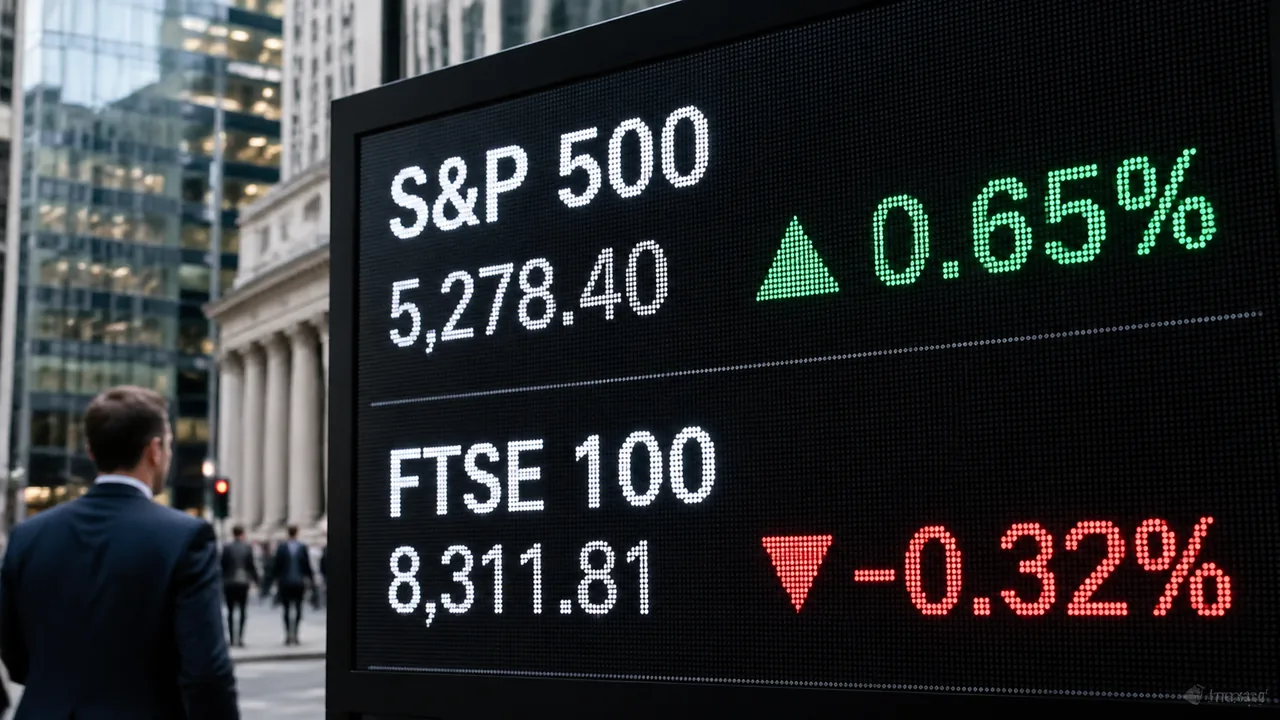
Stock market indices are benchmarks that track the performance of a group of stocks. The S&P 500, FTSE 100, Nikkei 225, and DAX are cited constantly in financial news, but what these numbers actually represent is often misunderstood.
How is a stock market index constructed?
An index is defined by its constituent stocks and its weighting methodology. The constituent list is maintained by an index committee and reviewed periodically (usually quarterly). Companies are added or removed based on specific criteria, typically market capitalisation, liquidity, and financial viability.
The most common weighting methods are:
- Market-cap weighting: Companies are weighted by their total market value (shares outstanding × share price). The S&P 500, FTSE 100, and most major global indices use this method. Larger companies have more influence on the index level. If a company’s share price rises, its weight in the index increases automatically.
- Price weighting: Companies with higher share prices have more influence, regardless of company size. The Dow Jones Industrial Average (DJIA) and Nikkei 225 use this method, which is increasingly criticised as arbitrary — a £500 share price does not reflect a company being twice as important as a £250 share.
- Equal weighting: Every constituent has the same weight. Less common in major indices but used in some ETF strategies as an alternative to market-cap weighting, which concentrates exposure in the largest companies.
How is the S&P 500 constructed and what does it measure?
The S&P 500 tracks 500 large US companies across all major sectors, weighted by market capitalisation. Membership is determined by an S&P index committee — not a purely mechanical rule — which evaluates candidates on several criteria:
- Market capitalisation above a minimum threshold (currently around $14.5 billion)
- US domicile and primary listing on a US exchange
- Sufficient liquidity (measured by annual trading value relative to market cap)
- At least one year of trading history as a publicly listed company
- Positive reported earnings in the most recent quarter and positive cumulative earnings over the four most recent quarters
Because of the market-cap weighting, the index is heavily concentrated in its largest components. The technology sector alone represents roughly 29–32% of the index, and the top 10 holdings (including Apple, Microsoft, Nvidia, Alphabet, and Amazon) collectively account for around 30–35% of the total index. This means the S&P 500’s performance is substantially driven by a handful of very large technology and technology-adjacent companies.
The S&P 500 is rebalanced quarterly — in March, June, September, and December — though additions and removals can happen at any time if a company is acquired, delisted, or no longer meets the criteria.
How is the FTSE 100 constructed and rebalanced?
The FTSE 100 tracks the 100 largest companies listed on the London Stock Exchange by market capitalisation. Unlike the S&P 500, it uses a largely mechanical rule: the 100 largest eligible companies by market cap are included, and the list is reviewed quarterly in March, June, September, and December.
The rules use buffer zones to avoid excessive churn. A company outside the top 100 must enter the top 90 to be promoted into the FTSE 100. A company inside the FTSE 100 must fall below 110th position to be relegated. This prevents constant switching for companies hovering around the boundary.
The FTSE 100’s sector composition differs significantly from the S&P 500. Energy (Shell, BP), financials (HSBC, Barclays, Lloyds), basic materials (mining companies including Rio Tinto, Glencore, Anglo American), and healthcare (AstraZeneca, GSK) are the dominant sectors. Technology has a much smaller weighting than in US indices. This composition means the FTSE 100 tends to outperform when commodity prices are high and underperform during periods of US technology stock strength.
An important characteristic: many FTSE 100 companies earn the majority of their revenue overseas, particularly in the US, in dollars. This means when sterling weakens against the dollar, reported earnings of FTSE 100 companies increase in sterling terms — which is one reason the FTSE 100 sometimes rises when the pound falls.
What other major indices are worth knowing?
Dow Jones Industrial Average (DJIA)
The oldest US index, tracking 30 large US companies selected by a committee. It is price-weighted, meaning a $500 stock has five times the influence of a $100 stock regardless of company size. Widely quoted in media but generally considered less representative than the S&P 500 given its narrow composition and price-weighting methodology.
NASDAQ 100
Tracks the 100 largest non-financial companies listed on the Nasdaq exchange. Heavily concentrated in technology: Apple, Microsoft, Nvidia, Meta, and Alphabet together represent a large proportion of the index. The NASDAQ 100 is more volatile than the S&P 500 because of this tech concentration — it falls harder during risk-off periods and rises more sharply during tech-led rallies.
DAX (Germany)
The benchmark German index covering the 40 largest companies on the Frankfurt Stock Exchange. Heavily weighted toward industrial, automotive (Volkswagen, BMW, Mercedes), and chemical companies, as well as SAP (technology) and Siemens. The DAX is a total return index, meaning it includes dividends reinvested — which makes it look higher than equivalent price-only indices and can cause confusion in direct comparisons.
Nikkei 225 (Japan)
Japan’s benchmark index tracking 225 companies listed on the Tokyo Stock Exchange. It is price-weighted (like the Dow Jones), which creates distortions. Technology and consumer electronics companies (Sony, Toyota, SoftBank) feature prominently. The Nikkei is sensitive to yen movements: a weaker yen boosts the overseas earnings of Japan’s export-heavy companies, often lifting the index.
Hang Seng (Hong Kong)
Tracks the largest companies listed on the Hong Kong Stock Exchange. Major constituents include HSBC, AIA, Tencent, and Alibaba. The Hang Seng is sensitive to both Chinese economic data and US–China trade and geopolitical relations, as many of its listed companies have significant mainland China operations.
CAC 40 (France)
The benchmark French index covering the 40 largest Paris-listed companies by market cap. Luxury goods (LVMH, Hermès, Kering) give the CAC 40 a distinctive sector profile not seen in other major European indices. Like many European indices, it is also sensitive to ECB policy and eurozone economic conditions.
MSCI World
An index covering approximately 1,400 large and mid-cap companies across 23 developed markets. The US represents roughly 65–70% of the index by market cap, making it heavily exposed to US equity performance. Widely used by institutional investors as a global diversified equity benchmark. Many low-cost global ETFs track this index.
What is the difference between price-weighted and market-cap-weighted indices?
The weighting methodology fundamentally changes which companies drive an index’s performance.
In a price-weighted index like the Dow Jones or Nikkei 225, a company with a share price of $500 has twice the influence on the index as a company priced at $250 — regardless of whether the $250 company is actually twice the size. A stock split (which reduces a share price without changing the company’s market value) mechanically reduces that company’s weight in a price-weighted index. This is widely regarded as an arbitrary and imprecise weighting method.
In a market-cap-weighted index like the S&P 500 or FTSE 100, the weight of each company is proportional to its total market value — share price multiplied by shares outstanding. A company worth $3 trillion has exactly three times the influence of a company worth $1 trillion. This is considered a more rational approach because it reflects the actual relative size of companies in the real economy.
The drawback of market-cap weighting is concentration: the largest companies become an ever-larger part of the index as their prices rise, which reduces diversification. The S&P 500’s heavy concentration in large technology companies has been a topic of debate among investors concerned about over-reliance on a single sector.
How does sector composition affect index behaviour?
An index’s sector composition largely determines how it responds to different economic environments.
The S&P 500’s technology weighting means it benefits disproportionately from periods of low interest rates (which support high growth stock valuations) and falls harder when rates rise (as happened in 2022, when the index fell roughly 19% for the year). Technology stocks are particularly sensitive to rate changes because their valuations rely heavily on future earnings discounted at the prevailing rate.
The FTSE 100, by contrast, benefits more from periods of high commodity prices and a weaker pound. Its energy and mining weighting means it often performs well during inflation cycles — exactly the periods when the S&P 500 struggles due to rate hike concerns.
Sector rotation — the movement of capital between sectors as the economic cycle progresses — is one of the primary drivers of relative index performance. Understanding which sectors dominate which index helps explain why two apparently similar equity indices can diverge significantly during the same period.
How do you invest in or trade an index?
There are several ways to gain exposure to index performance, each suited to different goals and time horizons:
- Index funds: Funds that track an index by holding its constituent stocks in the same proportions. Priced once daily. Typically the lowest-cost option for long-term investors and available through ISAs and SIPPs.
- Exchange-traded funds (ETFs): Like index funds but traded on stock exchanges throughout the day, like shares. Offer slightly more flexibility and are available on most retail investment platforms. Annual management costs (OCF) for major index ETFs are typically 0.03–0.20%.
- CFDs: Leveraged derivative instruments that track index prices without ownership. Suitable for short-term speculation. Overnight financing charges and leverage make them unsuitable for long-term investment. See the guide to CFDs explained for full detail on costs and risks.
- Futures: Standardised contracts to buy or sell an index at a set price on a future date. Lower financing costs than CFDs for medium-term positions, but require larger minimum trade sizes and more complex account types.
For most private investors with a multi-year time horizon, low-cost ETFs tracking broad indices like the S&P 500, FTSE All-Share, or MSCI World are among the most evidence-backed approaches available. The case for passive index investing is well established in the academic literature on investment returns.
Why does sector rotation matter for index investors?
Sector rotation describes the tendency of capital to flow between market sectors as the economic cycle progresses. During early expansion, cyclical sectors (consumer discretionary, industrials, financials) tend to lead. During late expansion and inflationary periods, energy and materials outperform. During recessions, defensive sectors (healthcare, utilities, consumer staples) tend to hold up better.
For investors holding market-cap-weighted indices, sector rotation does not require action — the index automatically reflects the changing composition of the market. But it explains why an index heavy in one sector may underperform a broader benchmark during certain parts of the cycle, and why holding multiple indices across different markets can reduce concentration risk.
How does index rebalancing work?
Major indices do not stay static. Most rebalance quarterly, adding and removing companies based on eligibility criteria. The announcement of index inclusion or exclusion often drives sharp price moves before the actual change takes effect. When a stock is confirmed for S&P 500 inclusion, every passive fund tracking the index must buy that stock before the addition date. That concentrated buying demand pushes the price up, sometimes by 5–10% in the days between announcement and inclusion. The reverse happens with deletions.
Related reading
- ETFs and index funds: the beginner’s case for passive investing
- CFDs explained: how contracts for difference work and what makes them risky
- Investing vs trading: the key differences and which approach suits you
- How to trade S&P 500 CFDs: what moves the index and how positions work
- What is a Stocks and Shares ISA and how does it work?
Frequently asked questions
How often is the S&P 500 rebalanced?
The S&P 500 is reviewed quarterly — in March, June, September, and December — with changes effective after the close of the third Friday of the relevant month. However, additions and removals can happen outside the regular schedule if a company is acquired, merged, or goes bankrupt. The S&P index committee makes discretionary decisions on eligibility, so the process is not purely mechanical.
What percentage of the S&P 500 is technology?
As of early 2025, the information technology sector represents approximately 29–32% of the S&P 500 by market cap, depending on how you classify certain companies. Adding communication services (which includes Alphabet and Meta) brings technology-adjacent exposure to around 40% of the index. The top five holdings alone — Apple, Microsoft, Nvidia, Amazon, and Alphabet — collectively account for roughly 25–30% of the entire index.
Can you buy shares in an index directly?
No. An index is a calculated number, not an investable product. You invest in funds, ETFs, or other instruments that track an index by holding its constituent stocks in the appropriate proportions. The index itself is a benchmark. The tracking fund is the actual investment vehicle, and different funds tracking the same index can have meaningfully different costs and tracking accuracy.
What is the difference between the FTSE 100 and FTSE 250?
The FTSE 100 covers the 100 largest companies listed on the London Stock Exchange by market capitalisation. The FTSE 250 covers the next 250 companies by size. FTSE 250 constituents are generally more domestically focused businesses, making the index a better reflection of UK economic conditions. When analysts want to gauge UK economic health specifically, they tend to look at the FTSE 250 more than the internationally oriented FTSE 100, which earns a large share of its revenues overseas.
Why does the FTSE 100 sometimes rise when the pound falls?
Most large FTSE 100 companies generate a significant portion of their revenue in US dollars, euros, and other non-sterling currencies. When the pound weakens against the dollar, those overseas revenues are worth more in sterling terms when translated back into the company’s reported accounts. That boosts reported earnings and, in turn, share prices. It is a currency translation effect, not a sign of improved underlying business performance.