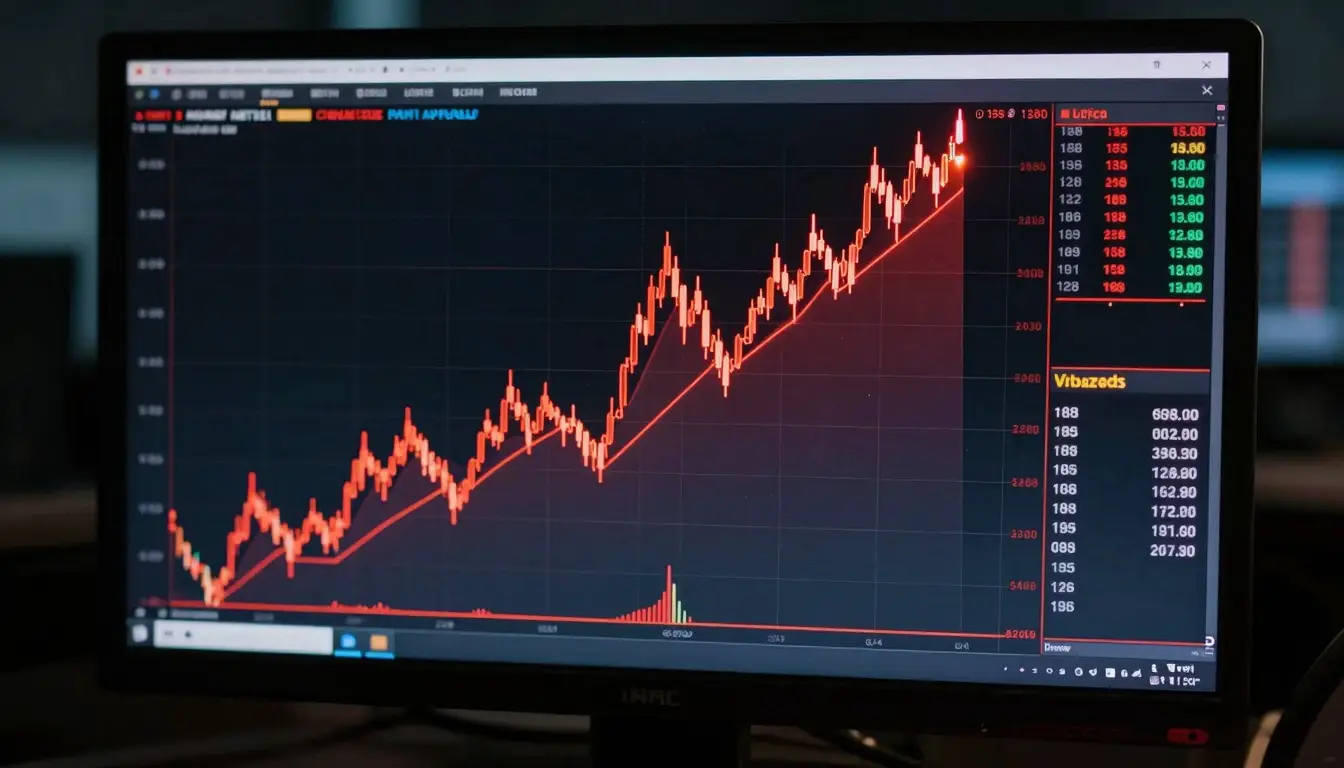
A perpetual futures contract (perp) lets you trade the price exposure of an asset without an expiry date. Unlike quarterly futures, which settle at a fixed date and converge to spot naturally, perps continue indefinitely. They stay anchored to the spot price through a funding rate: when the perp trades above spot, longs pay shorts; when it trades below spot, shorts pay longs. This payment adjusts every 8 hours on most exchanges and discourages prolonged divergence from spot.
How perpetual futures work
When you open a long perp position on BTC at $90,000 with 5x leverage, you put up $18,000 in margin and control $90,000 in exposure. If BTC rises to $95,000, your position gains $5,000 on $18,000 margin. If BTC falls to $85,000, you lose $5,000. If BTC falls far enough to consume your full margin, your position is liquidated and the margin is lost.
The funding rate runs continuously regardless of price movement. At 0.01% per 8 hours (the baseline rate in neutral conditions), holding a $90,000 long costs roughly $270 per day. At 0.05% per 8 hours (elevated during bull markets), that becomes $1,350 per day. These costs compound silently against flat or losing positions.
What this means for traders
Perps are the highest-volume trading instrument in crypto. On Binance, Bybit, and OKX, perpetual futures volume routinely exceeds spot volume by 3 to 5x. They offer leverage without holding the asset and allow short positions without borrowing costs. The leverage amplifies both gains and losses proportionally: a 10% adverse move on a 10x leveraged position wipes the entire margin.
See: funding rate explained, open interest explained, and crypto futures explained for how perps sit within the full derivatives picture.
A concrete example
BTC at $90,000. You open a 3x long on $10,000 margin, controlling $30,000 in exposure. Funding rate: 0.02% per 8 hours. Daily funding cost: $30,000 x 0.02% x 3 = $18 per day. BTC falls 8%: your position loses $2,400, leaving $7,600 margin (not yet liquidated). BTC then recovers 10%: position gains $3,000, leaving $10,600. Net after two days: +$600 on the position, minus $36 in funding. At 10x leverage, every 1% BTC move makes or loses $3,000 against the same $10,000 margin, changing the calculation entirely.
Frequently asked questions
What is the difference between perps and options?
A perp gives you linear exposure: if BTC rises 10%, your long gains 10% of notional. An option gives you non-linear exposure: you pay a premium upfront and your max loss is capped at that premium. Options are more complex but offer defined risk; perps have liquidation risk that can eliminate your position with no recovery.
Are on-chain perps safer than CEX perps?
On-chain perps (Hyperliquid, dYdX, GMX) remove the custodial risk of a centralized exchange holding your margin. FTX is the case study: perp margin held on FTX was lost in the collapse. On-chain perps require trusting the smart contract instead of the exchange. Both carry risk; the type differs.
What leverage should I use?
Most professional traders in crypto use 2x to 5x on directional trades. Above 10x, a single volatile candle can eliminate your position, funding costs are high, and liquidation distances are tight. Start with 1x to 3x while developing your position sizing discipline before increasing leverage.