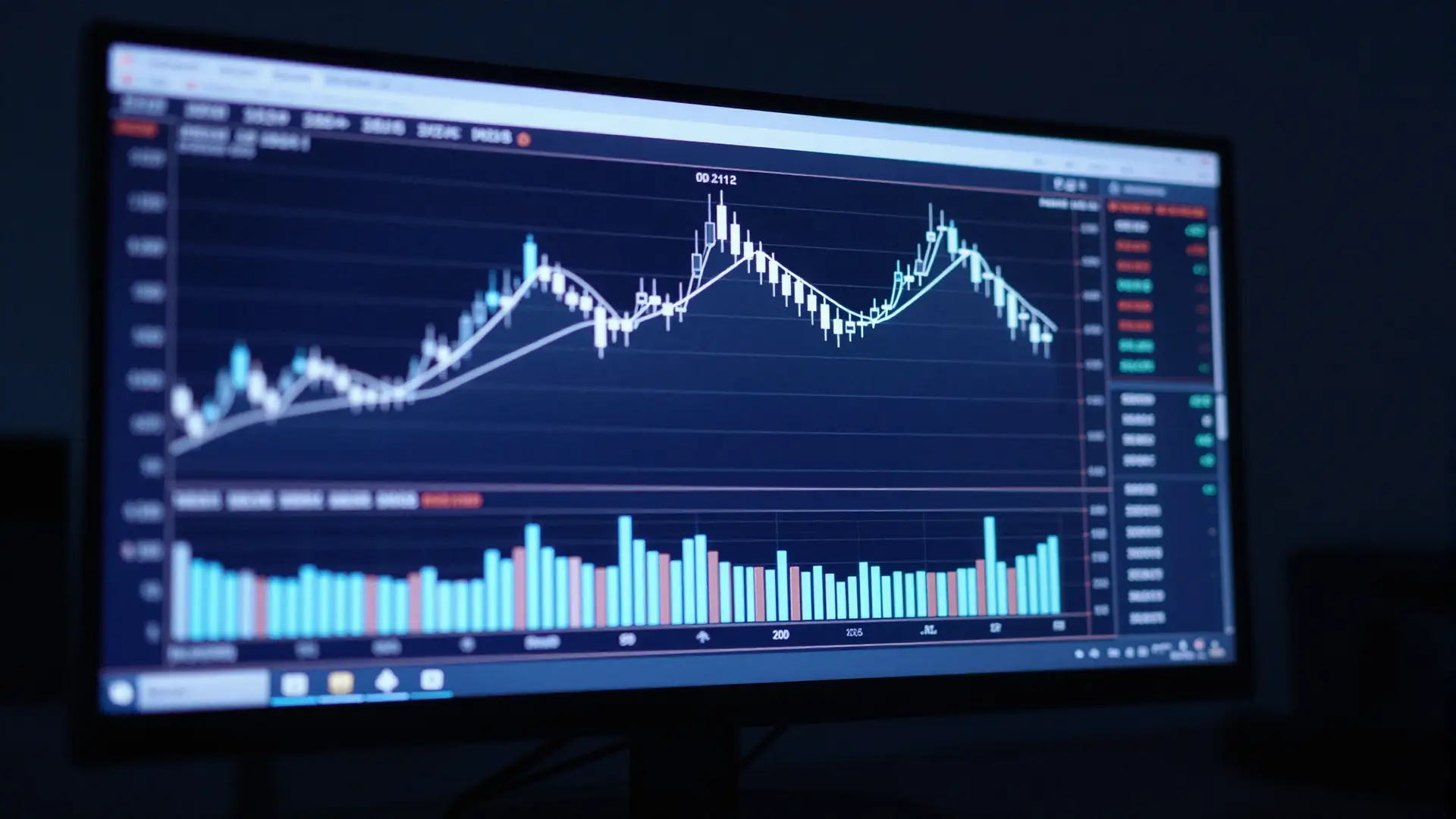
VWAP stands for Volume-Weighted Average Price: the average price an asset has traded at over a period, weighted by how much volume traded at each price. Unlike a simple average, it counts prices where lots of shares changed hands more heavily than prices with thin trading. Traders and institutions use it as a benchmark for the day’s “fair” price, and as an intraday reference for entries and exits.
In short: VWAP is the volume-weighted average price for a session. Price above VWAP is often read as intraday strength, price below as weakness. It resets each day and is mainly an intraday tool.
How is VWAP calculated?
VWAP runs cumulatively through the trading day. For each period you take the typical price, the average of the high, low, and close, multiply it by the volume traded, and keep a running total. VWAP is that running total of price-times-volume divided by the running total of volume:
VWAP = cumulative (typical price × volume) ÷ cumulative volume
Because it is cumulative from the market open, VWAP resets at the start of each session. Charting platforms plot it as a single line, and you almost never calculate it by hand, but knowing the formula explains its behaviour: heavy-volume prices pull the line toward them, and the line grows steadier as the day builds more data.
What do traders use VWAP for?
- A fair-value benchmark. Large institutions aim to buy below VWAP and sell above it, so they are not moving the market against themselves. It is a yardstick for execution quality.
- Trend bias. Price holding above VWAP through the day suggests buyers are in control; price stuck below suggests sellers are. Many intraday traders only look for longs above VWAP and shorts below it.
- Dynamic support and resistance. Price often pulls back toward VWAP and bounces, so traders watch it as a level to enter in the direction of the trend.
VWAP vs a moving average: what is the difference?
A simple moving average weights every period equally, whether one share or a million traded. VWAP weights by volume, so it reflects where trading actually concentrated. That makes VWAP a better read on the price most participants agreed on during a session. The trade-off is that VWAP is built for the intraday timeframe and resets daily, whereas moving averages work across any timeframe, from minutes to years.
What are the limitations of VWAP?
VWAP is an intraday indicator: because it resets each day, it is far less useful for swing or position trading over days and weeks. It is also backward-looking, describing where price has been rather than predicting where it will go, and in the first minutes after the open it is jumpy because there is little volume behind it. Like any single indicator, it works best as one input alongside momentum tools and sound position sizing, not as a standalone signal.
Related reading
- RSI, MACD, and Bollinger Bands: how these indicators work
- Position sizing: how to calculate the right trade size
- Stop-loss orders: where to place them and the trade-offs involved
Frequently asked questions
Is VWAP a good indicator for beginners?
VWAP is simple to read, which makes it beginner-friendly as a bias tool: above the line leans bullish, below leans bearish. But it only applies intraday and should never be traded in isolation. A beginner is better off using VWAP to confirm a direction they already have a reason to trade, combined with a stop-loss, rather than buying or selling purely because price crossed the line.
What does it mean when price is above or below VWAP?
Price above VWAP means the average buyer so far today is in profit and buyers have been the stronger side; it is read as intraday strength. Price below VWAP means the reverse, sellers have had the upper hand and the average buyer is underwater. Traders use this as a quick gauge of who is winning the session, though a cross of the line alone is not a reliable trade signal.
Does VWAP work on all timeframes?
No. Standard VWAP is designed for a single trading session and resets at each market open, so it is an intraday tool. For longer horizons, traders use an “anchored VWAP” that starts from a chosen date or event, or switch to moving averages, which work across any timeframe. Using standard VWAP for swing trades over several days gives little meaningful information.
This article is educational and not financial advice. Trading carries risk and most retail accounts lose money. VLT Markets is a publisher, not a broker.