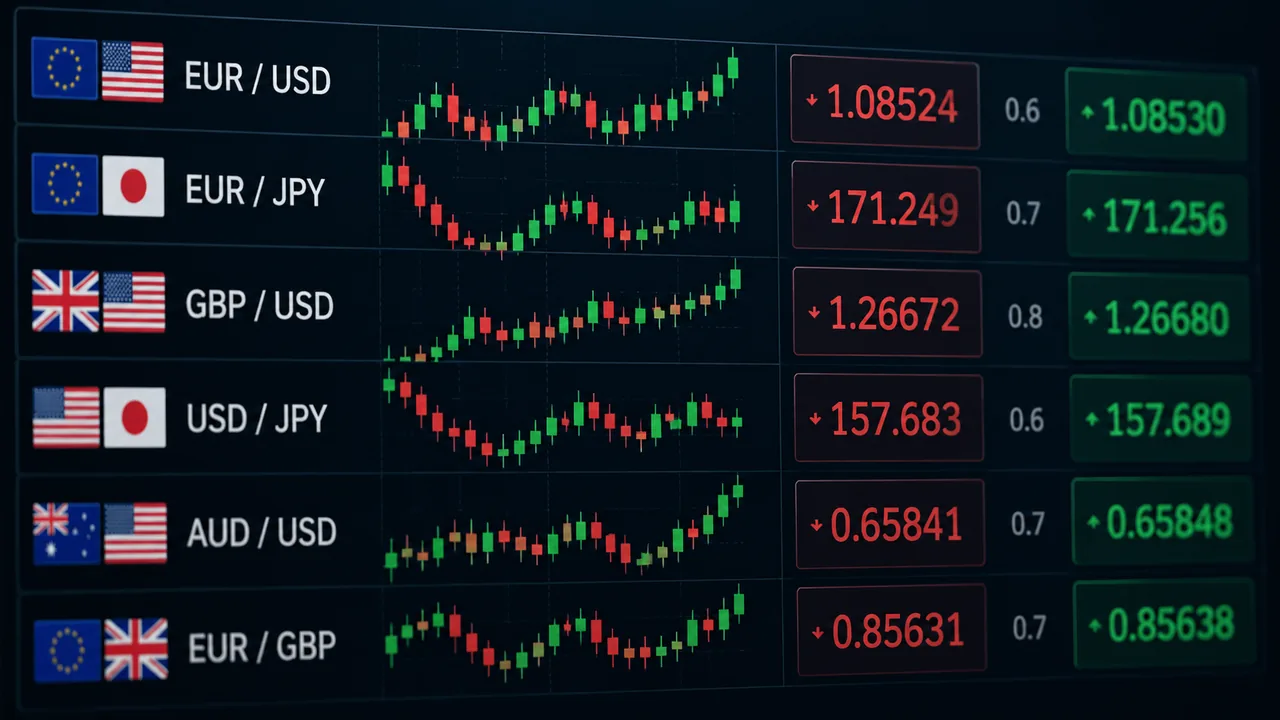
Forex traders organise currency pairs into three groups: majors, minors (also called crosses), and exotics. The category a pair falls into affects its liquidity, typical spread, and trading conditions.
What are major currency pairs?
Major pairs always include the US dollar on one side. There are seven commonly recognised majors, each representing the exchange rate between the dollar and a major world economy:
- EUR/USD — Euro vs US dollar. The eurozone (19 countries) versus the world’s largest economy. The most traded pair globally, accounting for roughly 22% of daily forex volume.
- USD/JPY — US dollar vs Japanese yen. Japan’s export-driven economy and the BoJ’s long-running ultra-loose monetary policy make this pair sensitive to risk sentiment globally.
- GBP/USD — British pound vs US dollar, nicknamed “cable” after the transatlantic telegraph cable used for quotes in the 19th century. Driven heavily by UK economic data and Bank of England policy.
- AUD/USD — Australian dollar vs US dollar. Australia’s economy is commodity-export-dependent, making AUD/USD sensitive to iron ore, copper, and Chinese demand data.
- USD/CAD — US dollar vs Canadian dollar, nicknamed “the loonie.” Canada’s energy exports mean oil prices significantly influence this pair.
- USD/CHF — US dollar vs Swiss franc. The Swiss franc is considered a safe-haven currency; the pair often strengthens (CHF rises) during global risk-off episodes.
- NZD/USD — New Zealand dollar vs US dollar, sometimes called “the kiwi.” Commodity exports and RBNZ policy decisions are primary drivers.
These pairs account for the large majority of daily forex volume. Because they are so heavily traded, spreads are typically tight, often under one pip for EUR/USD during peak hours.
What are minor pairs and cross pairs?
Minor pairs, also called cross pairs or simply crosses, do not include the US dollar. Instead, they pair two major currencies directly. The most actively traded crosses are:
Euro crosses
- EUR/GBP — Euro vs British pound. Driven by divergence in ECB and Bank of England policy. Relatively stable under normal conditions, but Brexit news drove extreme volatility between 2016 and 2020.
- EUR/JPY — Euro vs Japanese yen. A popular carry trade pair given the BoJ’s historically low rates. Also sensitive to global risk sentiment.
- EUR/CHF — Euro vs Swiss franc. The Swiss National Bank has historically intervened to prevent excessive franc appreciation, making this pair unusual in its behaviour.
- EUR/AUD, EUR/CAD, EUR/NZD — Euro against commodity-linked currencies. Less liquid than the above, but used by traders wanting pure eurozone exposure.
Sterling crosses
- GBP/JPY — Known as “the dragon” for its volatility. Wide daily ranges make it attractive to range traders but dangerous for those with tight stop-losses. GBP/JPY can move 150–200 pips in a single session during active periods.
- GBP/CHF, GBP/AUD, GBP/CAD, GBP/NZD — Sterling against other majors. GBP/AUD in particular can be volatile during Asian hours when AUD sees active trading.
Other notable crosses
- AUD/JPY, NZD/JPY, CAD/JPY — Commodity currencies against the yen. Popular carry trade vehicles when global risk appetite is strong.
- AUD/NZD — Two closely related commodity-driven economies. Moves are often driven by relative central bank policy divergence (RBNZ vs RBA).
What are exotic currency pairs?
Exotic pairs combine a major currency with one from a smaller or emerging market economy:
- USD/TRY — US dollar vs Turkish lira. The lira has experienced dramatic depreciation driven by unconventional monetary policy and high inflation in Turkey.
- USD/ZAR — US dollar vs South African rand. Influenced heavily by commodity prices (gold, platinum) and South African political risk.
- USD/MXN — US dollar vs Mexican peso. Sensitive to US trade policy and nearshoring trends given Mexico’s proximity to the US economy.
- EUR/PLN — Euro vs Polish zloty. Poland’s increasing integration with the eurozone economy means this pair tracks ECB decisions closely.
- USD/SGD, USD/HKD — Dollar pairs with Asian financial centre currencies. HKD is pegged to the USD so this pair trades in a very narrow range.
Spreads on exotics are significantly wider than on majors, often five to fifty times wider. Political instability or economic shocks in the smaller economy can move the pair sharply. Most retail traders focus on majors or the more liquid crosses for this reason.
Why does liquidity matter when choosing a pair?
A more liquid pair has more buyers and sellers at any moment. Trades execute at or close to the quoted price, and slippage — the gap between expected and actual execution price — is less likely. Tighter spreads also mean lower costs per trade. For a trader making multiple trades per day, choosing a liquid pair over an exotic can meaningfully affect returns over time.
How do spread costs differ across pair types?
One of the most practical differences between pair types is the cost of entering a trade. Spreads vary significantly depending on the liquidity of each pair. Below are typical indicative spreads under normal market conditions. These will vary by broker and widen during low-liquidity periods such as news events or the Asian session for European pairs.
| Pair type | Example pairs | Typical spread |
|---|---|---|
| Major | EUR/USD | 0.1 – 0.5 pip |
| Major | GBP/USD | 0.5 – 1 pip |
| Minor (cross) | EUR/GBP | 0.5 – 1.5 pips |
| Minor (cross) | GBP/JPY | 1 – 3 pips |
| Exotic | USD/TRY | 20 – 80 pips |
| Exotic | USD/ZAR | 30 – 100 pips |
For a full explanation of how these costs affect your returns over time, see the guide to spreads and commissions.
Which pairs are best for beginners?
EUR/USD and GBP/USD are the most practical starting points for beginners, for three concrete reasons.
First, the spreads are the tightest available. EUR/USD can trade at 0.1 of a pip with a competitive broker during peak London hours. That means your entry cost is minimal, which matters when you are still learning and making mistakes.
Second, the analysis available for these pairs is vast. Thousands of analysts, banks, and independent traders publish research on EUR/USD and GBP/USD every day. For a beginner learning to interpret economic data or central bank language, that abundance of context is genuinely useful.
Third, the price action is relatively clean. Deep liquidity means fewer erratic gaps and spikes. Large spreads on exotic pairs can generate false signals on charts that would not exist on major pairs.
A practical approach is to spend the first six months exclusively on one pair — ideally EUR/USD — and learn its rhythms, how it reacts to US CPI data, Fed meeting outcomes, eurozone growth figures, and risk-off events. That focused learning transfers to other pairs later far more effectively than trying to trade several at once from the start.
How do currency pairs correlate with each other?
Currency pairs do not move independently. EUR/USD and GBP/USD tend to move in the same direction most of the time because both are measured against the US dollar and both economies share significant trade ties. When the dollar strengthens broadly, both pairs tend to fall together.
EUR/USD and USD/CHF have a historically strong inverse relationship. Both involve the euro or franc against the dollar, but because CHF is quoted as the quote currency in USD/CHF, a stronger dollar pushes USD/CHF up while pushing EUR/USD down. This negative correlation has historically been around –0.90 at peak periods, meaning they move almost perfectly opposite to each other.
USD/JPY and EUR/USD often also move in opposite directions for similar structural reasons. A stronger dollar pushes EUR/USD down but USD/JPY up, because JPY is the quote currency in that pair.
AUD/USD has a notable correlation with commodity prices, particularly iron ore and copper, because Australia’s economy is heavily resource-export-driven. This means AUD/USD often reacts to Chinese economic data as much as to US data.
The practical risk is this: if you open a long EUR/USD and a long GBP/USD at the same time, you are not diversifying. You are doubling your exposure to the same underlying move. Treating correlated pairs as separate trades is a common mistake that overstates how spread out a portfolio actually is.
Which pairs suit which trading style?
Major pairs are best suited to scalpers and day traders. The spreads are tight enough that short-duration trades remain profitable after costs, and the liquidity ensures orders fill cleanly at or near the quoted price.
Minor crosses are more appropriate for medium-term traders holding positions for days or weeks. A slightly wider spread matters less over a multi-day move, and crosses can offer cleaner trends driven by regional economic divergence rather than broad dollar moves. EUR/GBP, for example, tracks the relative strength of the eurozone versus the UK economy with no dollar influence, which can make it easier to analyse using purely European data.
Exotic pairs should generally be reserved for experienced traders with a high risk tolerance and a specific reason to trade that particular economy. The spread alone can represent a significant percentage of the expected move. For a broader introduction to how the market works across all pair types, see how the forex market works.
Related reading
- How the forex market works: a plain-language guide
- How central bank decisions move currency markets
- Spreads and commissions: how broker costs affect your trading returns
- Leverage in trading: how it amplifies both gains and losses
- How to choose a trading broker: the checks that matter before depositing
Frequently asked questions
What are the best currency pairs for beginners?
EUR/USD is the standard recommendation: tightest spreads, deepest liquidity, most analysis available. GBP/USD is a solid second choice for UK-based traders who want to follow a pair tied to familiar domestic economic events. Avoid exotics and high-volatility crosses like GBP/JPY until you have a consistent track record on the major pairs.
What is the most traded currency pair?
EUR/USD is the most traded currency pair in the world, accounting for roughly 22% of total daily forex volume according to the BIS 2022 Triennial Survey. That level of activity means extremely tight spreads, deep liquidity, and extensive freely available analysis, all of which make it the default starting point for most forex traders.
Which are the most volatile currency pairs?
Among the commonly traded pairs, GBP/JPY is consistently one of the most volatile, with daily ranges regularly exceeding 100 pips. Exotic pairs involving emerging market currencies — USD/TRY, USD/ZAR — can be more volatile still, especially during political or economic stress. Higher volatility means larger potential moves in both directions, wider spreads, and greater risk of being stopped out before a trade works.
What affects GBP currency pairs?
Bank of England interest rate decisions and forward guidance are the primary driver of GBP. UK inflation data (CPI), employment figures, GDP releases, and wage growth all influence BoE expectations and therefore sterling. Post-Brexit, UK–EU trade relations add an additional layer of political sensitivity. GBP pairs also react to global risk sentiment: sterling tends to weaken during broad risk-off periods as investors move to safer currencies.
Can I trade cross pairs without dollar exposure?
Yes, and that is specifically why cross pairs exist. EUR/GBP gives you exposure to the euro versus the pound with no direct US dollar position in the trade. GBP/JPY gives you pound versus yen. This can be useful for traders who want to express a view on two specific economies without taking a view on the US dollar at the same time.