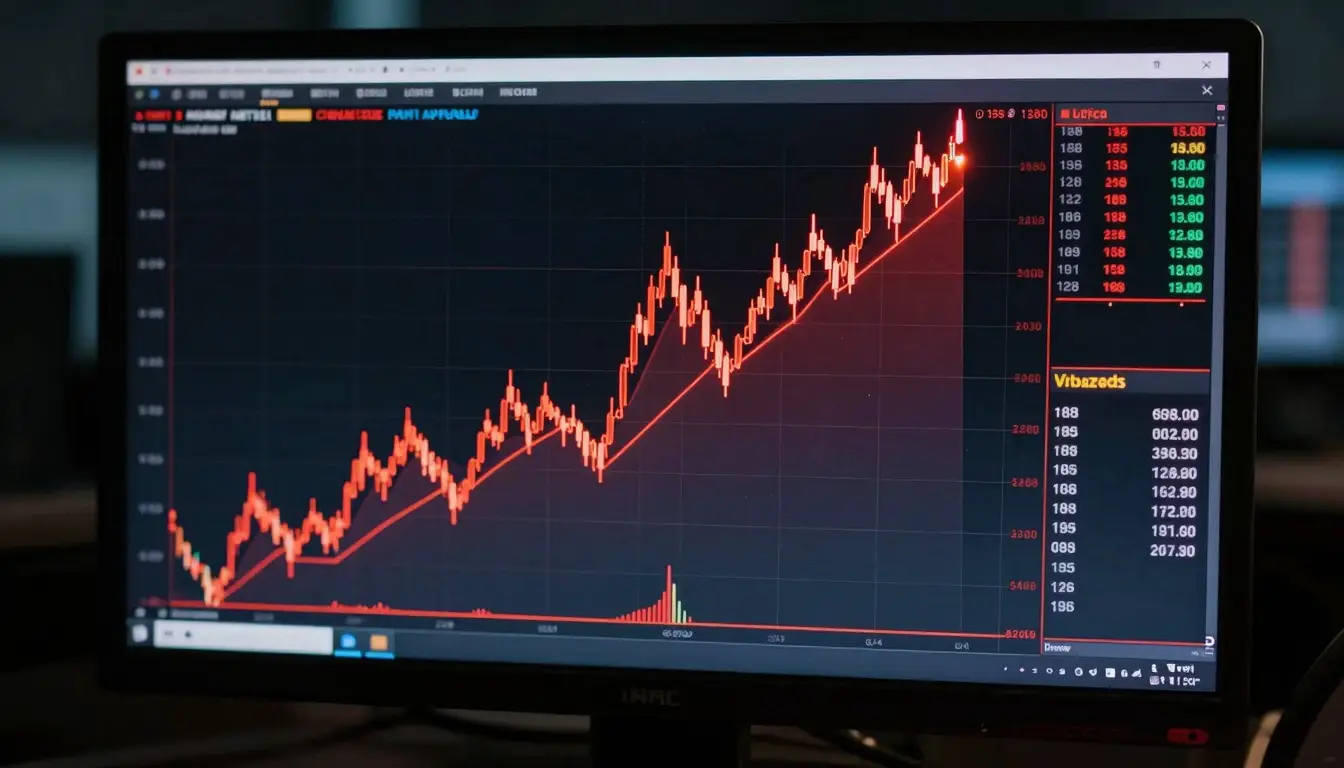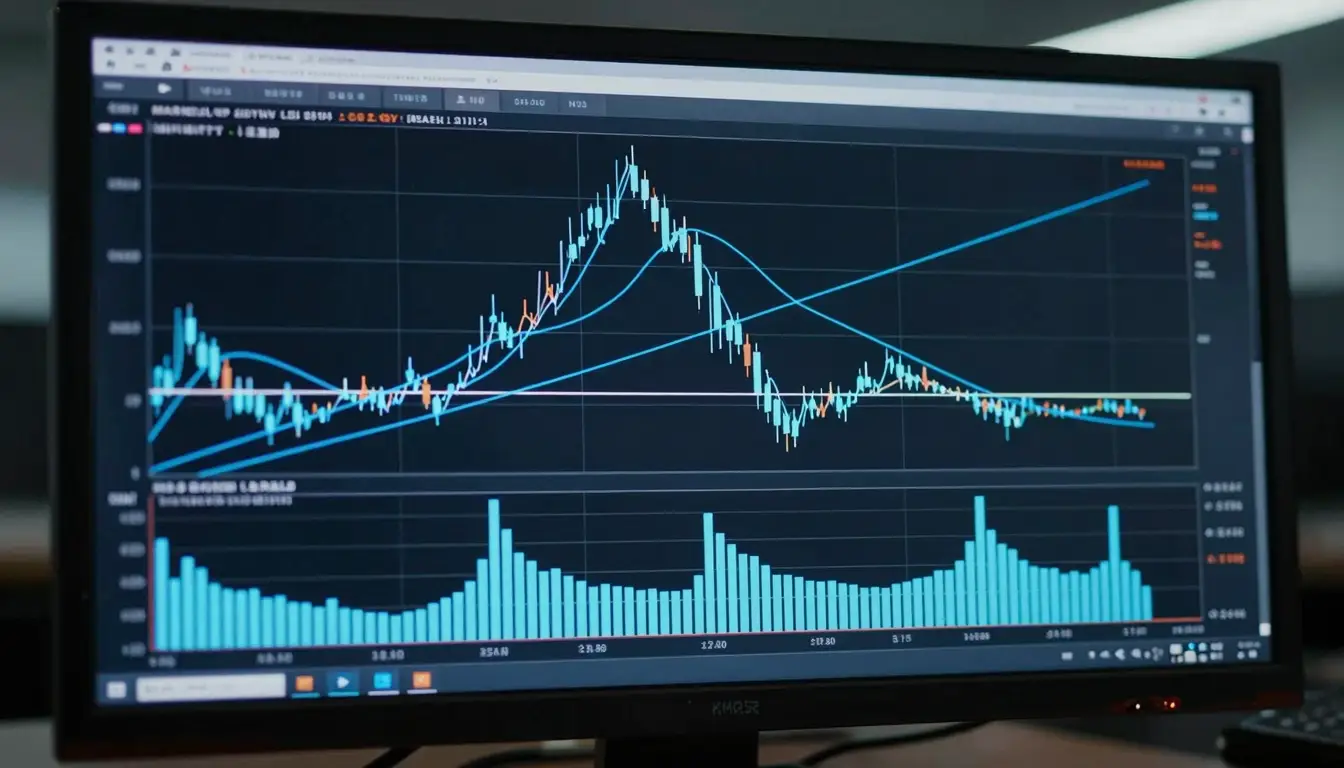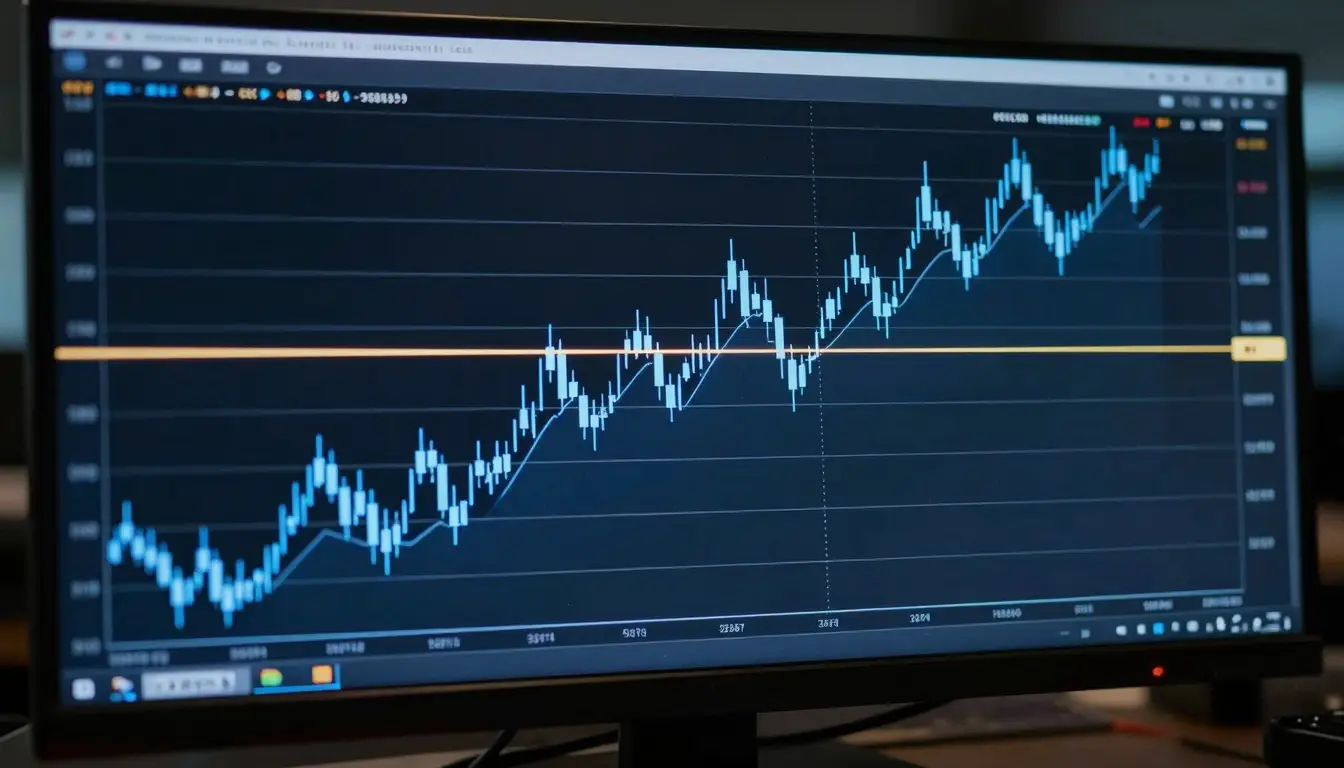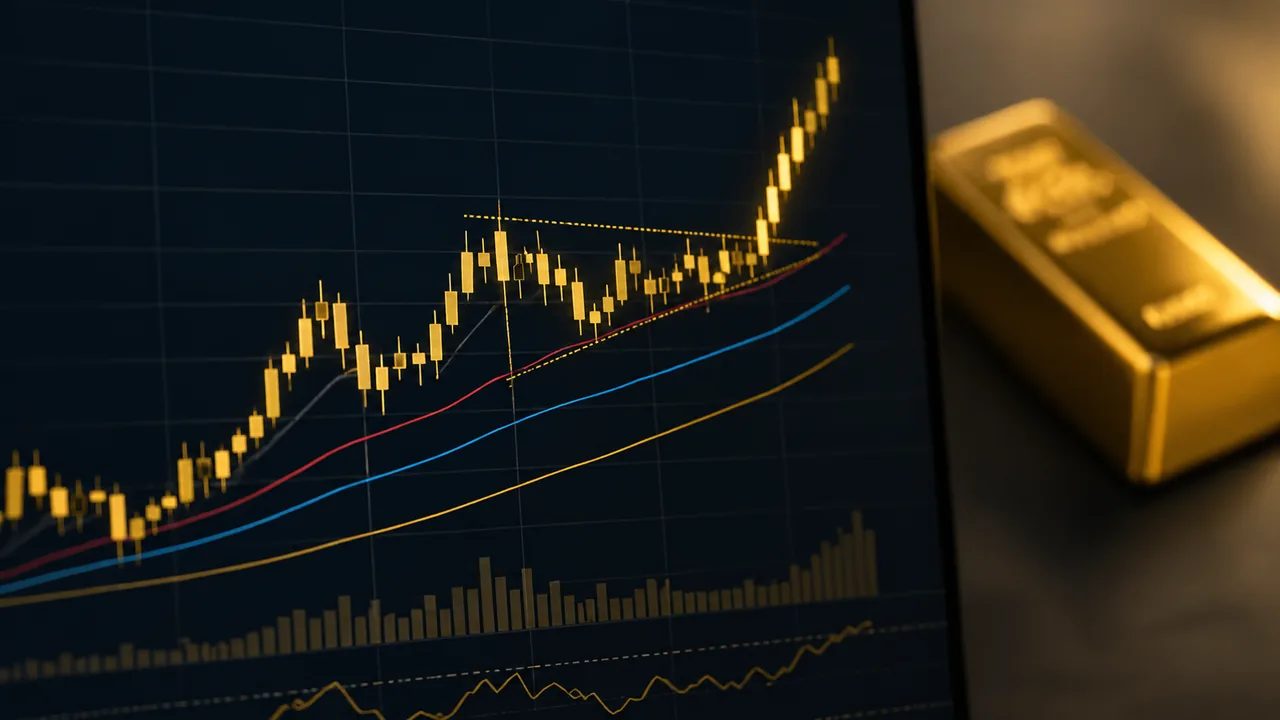
Gold (XAU/USD) spent much of 2024 and 2025 in a sustained uptrend, gaining over 70% from 2024 lows to 2025 highs. This kind of directional movement rewards trend followers and punishes traders who try to fade every move. Understanding which approach suits the current market condition is more important than knowing any one strategy in isolation. This guide covers each of the three core strategies for trading gold in detail — including specific entry setups, stop-loss placement, and target methodology — plus how to filter them using fundamental catalysts and how to combine them into a single coherent framework.
Strategy 1: Trend following — the default approach for directional gold markets
Trend following means trading in the direction of the prevailing trend rather than trying to pick tops or bottoms. Gold’s tendency to make sustained directional moves — driven by the slow-moving macro forces of real interest rates, dollar policy, and central bank demand — makes it well-suited to this approach.
Confirming trend direction: Use the daily chart as your primary trend reference. The 50-day and 200-day exponential moving averages (EMAs) provide the clearest structural signal. When the 50-day EMA is above the 200-day EMA and price is trading above both, the trend is up. When the 50-day crosses below the 200-day (the “death cross”), the trend has turned. This moving average alignment is visible on any charting platform and broadly followed enough that it becomes partially self-reinforcing — when the cross occurs, many participants act on it simultaneously.
A supporting confirmation is the slope of the 200-day EMA itself. A rising 200-day EMA confirms an established uptrend. A flat or declining 200-day suggests caution even if price is temporarily above it.
Entry triggers: Rather than buying into a rising market at any point, trend-following entries are most effective on pullbacks to key levels. Suitable pullback targets include: the 20-day EMA (often the first level a healthy trend respects), a prior swing high now acting as support after being broken, the 50-day EMA (a deeper pullback in a strong trend), and Fibonacci retracement levels — particularly the 38.2% and 50% retracements of the last identifiable upswing.
An entry signal at these levels is not simply that price is near the moving average. You want a confirmation candle — a bullish engulfing candle, a hammer, or a strong rejection wick from the support level — to suggest buyers are defending the level before you enter.
Stop-loss placement: Place the stop below the pullback low — the recent swing low from which you expect the trend to resume. If gold pulls back to $2,800 and forms a hammer candle with a low at $2,785, your stop goes at $2,780 or a few dollars below the candle low, outside the range of normal noise. The stop must be below a structurally meaningful level, not an arbitrary dollar amount above your entry.
Targets: In an established uptrend, the most natural targets are prior swing highs, round numbers, and extended Fibonacci levels such as the 127.2% or 161.8% extension of the previous corrective swing. For a swing trade, a minimum risk-reward ratio of 1:1.5 to 1:2 is a sensible filter — if the nearest logical target doesn’t offer at least 1.5 times the stop distance, the setup’s expected value is insufficient to justify the trade.
Rough characteristics: Trend-following on gold daily charts typically generates win rates of 40-55% in trending markets, with winners averaging larger than losers due to the ability to trail stops. In choppy, non-trending conditions, win rates can fall below 40% and the approach gives back a significant portion of trend profits. Identifying the current regime correctly is the most important variable.
Strategy 2: Breakout trading — capitalising on gold’s consolidation and expansion cycles
Gold frequently consolidates in a defined range for days or weeks before making a sharp directional move. This compression-and-expansion cycle creates breakout opportunities — entries made when price escapes a consolidation zone, targeting a move equal to the width of the range that preceded it.
Identifying consolidation ranges: A consolidation worthy of a breakout trade has specific characteristics. It should have tested the same resistance level at least twice without closing above it, and the same support level at least twice without closing below it. The range should span at least five to ten trading sessions — shorter “consolidations” are often just normal intraday noise. The Average True Range (ATR) of sessions within the range will typically contract relative to the prior trend, confirming that directional energy is being stored rather than released.
On gold, key levels that define meaningful consolidations include all-time highs, prior swing highs that have been retested multiple times, and round numbers ($2,500, $3,000, $3,500). When gold spends multiple sessions testing the same level without breaking it decisively, the eventual break carries more significance than a single-candle spike.
Measuring breakout targets: The classic method is to measure the height of the consolidation range and project that distance from the breakout point. If gold is consolidating between $2,900 and $2,940 (a $40 range), a breakout above $2,940 projects a target of $2,980. This is a mechanical target and should be reviewed against nearby resistance levels — if there is a major prior swing high at $2,960, that becomes the more conservative target.
False breakout protection: False breakouts — where price spikes above a level and quickly reverses — are one of the most frustrating aspects of breakout trading. Several filters reduce their frequency:
- Wait for a daily candle to close above the resistance level, not merely trade through it intraday. Many false breakouts are intraday spikes that close back within the range.
- Enter on the retest. After a confirmed close above resistance, wait for price to pull back to the broken level (which should now act as support) before entering. This gives a tighter stop and better risk-reward, though it means missing fast-moving breakouts that do not retest.
- Avoid entering into breakouts ahead of known high-impact events. A breakout caused by a Federal Reserve statement is genuine; a breakout in the overnight session on thin volume is more suspect.
Rough characteristics: Breakout strategies in gold typically show win rates in the 35-45% range, with successful trades producing larger returns relative to the initial risk. The asymmetry between winners and losers means the strategy can be profitable overall even with a sub-50% win rate, provided the average win is at least twice the average loss.
Strategy 3: Range trading — when gold is moving sideways
When gold lacks a clear trend, it often oscillates between identifiable support and resistance zones. Range trading means buying near the bottom of the range and selling (or shorting) near the top, with stops placed just outside the range boundaries.
Defining the range: A tradeable range requires clear, well-tested boundaries — at least two confirmed bounces from support and two rejections from resistance. The range should be wide enough relative to your stop to provide a viable risk-reward ratio. If support is at $2,800 and resistance at $2,820, the $20 range is too narrow to trade profitably once spreads and stop placement are factored in. A range of $40-80 is more workable for most retail account sizes.
Entry methodology: Entries near support use the same candle confirmation logic as trend-following pullback entries — look for a rejection wick, engulfing candle, or RSI turning upward from below 40 as confirmation that buyers are stepping in at the level. Entries near resistance similarly look for a bearish rejection candle or RSI turning down from above 60-65. Do not enter simply because price is near support or resistance; wait for a signal that the level is actively holding.
Stop and target placement: Stop-losses go just outside the range boundary — a few dollars below support for long trades, a few dollars above resistance for short trades. Targets are set at the opposite boundary. Risk-reward on a well-defined range trade is determined by the range width relative to the stop width. A range of $60 with a stop $15 outside the boundary offers 60/15 = a 4:1 target ratio, though in practice you would target the middle of the range or slightly inside the opposite boundary to account for the probability of falling short.
When range trading fails: The critical risk in range trading is a genuine breakout. If gold breaks decisively through the range boundary — especially on high volume or following a major catalyst — the range is over and a trend-following or breakout trade becomes relevant instead. Stopping out immediately when the range boundary is broken, rather than hoping price returns, is the discipline that keeps range trading viable as a strategy.
How to use fundamental catalysts to filter strategy signals
Gold is one of the most macro-sensitive instruments available to retail traders. No technical setup should be taken in isolation from the fundamental context. Several specific catalyst types are particularly relevant:
Federal Reserve meetings (FOMC): FOMC decisions and the subsequent press conferences are among the highest-impact events for gold. Any signal of a shift in rate policy — toward cuts or hikes — typically produces a sharp directional move in gold. Holding positions through FOMC events without reducing size is a risk that many experienced traders avoid. A common approach is to wait for the initial reaction to settle before entering new trend-following or breakout trades in the direction of the post-event move.
US inflation data (CPI): Monthly US CPI releases are scheduled events with high potential to move gold. Higher-than-expected inflation can be bullish for gold (real yields fall) or bearish (if the market interprets it as increasing the probability of Fed rate hikes). The market’s interpretation of the number — rather than the number itself — determines the direction. Following the initial reaction and trading in its direction is often more reliable than trying to predict the move in advance.
Geopolitical events: Unscheduled events — military escalations, banking system stress, sudden political crises — can trigger sharp gold rallies. These events cannot be anticipated in most cases, but they can be used to filter out entry signals that arise in the wrong direction. If gold is in an uptrend and a geopolitical shock produces a large single-day rally, the subsequent pullback to support is a higher-quality trend-following entry context than the same setup on an otherwise quiet day.
A practical filter for all three strategies: before entering any gold trade, check the economic calendar for any high-impact events in the next 24 hours. If a Fed meeting, NFP, or CPI print is imminent, either wait until after the event or significantly reduce position size to manage gap risk.
How to combine all three strategies into a single framework
Trend following, breakout trading, and range trading are not separate systems that conflict with each other. They can be applied within a single multi-timeframe framework that adapts to current conditions:
Step 1 — Determine regime on the daily chart. Are the 50-day and 200-day EMAs pointing up with price above both? Trend-following mode. Is price oscillating between the same support and resistance levels with flat moving averages? Range trading mode. Is price breaking out of a multi-week consolidation? Breakout mode.
Step 2 — Drop to H4 or H1 for entry precision. In trend-following mode, look for short-term consolidations on the H4 chart within the broader uptrend. When the H4 consolidation breaks in the trend direction, that is the specific entry trigger. This combines the clarity of trend-following with the precision of a breakout entry.
Step 3 — Check fundamental calendar before executing. If a major catalyst is within 24 hours, defer or reduce size.
Step 4 — Apply risk management. Calculate position size based on stop distance, not on gut feeling or round numbers. Record the trade. Review results weekly. Before entering any trade using this combined method, reviewing your expected risk-reward ratio and checking your stop-loss placement against the current volatility environment is essential.
Risk management specific to gold’s volatility
Gold’s volatility is structurally higher than most major forex pairs. EUR/USD might move 50-80 pips on a normal day. Gold regularly moves $20-40 per ounce, which on a standard contract (100 oz) translates to $2,000-4,000 of dollar movement per day. This means stops that work in forex will frequently be too tight for gold.
Several principles help keep risk appropriate for gold’s specific characteristics:
- Use ATR to set stops, not arbitrary pip amounts. Gold’s 14-day ATR provides a data-driven baseline for the typical daily range. A stop should be at minimum one ATR away from entry to avoid being triggered by normal price noise.
- Use micro or mini contracts. A $30 stop on a standard lot (100 oz) is $3,000 of potential loss. On a micro contract (1 oz), the same stop is $30. Matching contract size to account size and risk tolerance is not optional — it is the foundation of survival.
- Reduce size before major events. The possibility of a large, fast move through a stop-loss is higher around FOMC decisions, US CPI, and NFP. Cutting size by half or more before these events is standard practice among experienced gold traders.
- Do not move stops against the trade. Widening a stop-loss because price is approaching it converts a defined-risk trade into an open-ended loss. The stop should only move in the direction of the profit, never against it.
See the guide to position sizing for a method to calculate exactly how many ounces to trade based on your account size and stop distance.
Related reading
- How to trade XAU/USD: gold as a currency pair explained
- Position sizing: how to calculate the right trade size for your account
- Stop-loss orders: where to place them and the trade-offs involved
- Risk-reward ratios: what they mean and how to use them
- Volatility: what it is, how it is measured, and why it matters
Frequently asked questions
Which timeframe is best for trading gold?
It depends on your schedule and risk tolerance. Swing traders using daily charts typically hold positions for two to ten days and target moves of $30–100 per ounce or more. Day traders using H1 or H4 charts aim to open and close within the trading day, targeting $10–30 per ounce. Scalpers on five-minute or fifteen-minute charts target $3–8 moves but trade far more frequently. There is no universally superior timeframe. What matters is that your stop distance, target size, and position sizing are all calibrated to your chosen timeframe, so that risk-reward ratios remain consistent and meaningful. Beginners typically find the daily chart less stressful and more forgiving of imprecise entries than intraday charts.
How do I trade around the London gold fix?
The LBMA sets the gold price twice daily at 10:30am and 3:00pm London time (BST in summer, GMT in winter). The 3:00pm fix in particular often creates a surge in volume and short-term directional movement as institutional participants benchmark and rebalance positions. Some traders watch for directional momentum in the 15–30 minutes before the 3pm fix and trade with the developing move. This is not a guaranteed signal — the fix can produce reversals as well as continuations — but the increase in activity creates genuine trading opportunities for those who know the timing. The 3pm window broadly aligns with the early New York session, reinforcing the activity increase.
Is gold suitable for day trading?
Gold is commonly day traded and has characteristics that suit intraday approaches: it has tight spreads during London and New York hours, responds clearly to scheduled events, and has sufficient daily range ($15–40 per ounce typically) to generate meaningful profit opportunities on smaller contract sizes. The challenges are that gold is highly macro-driven, meaning unexpected news can produce large, fast moves that overrun stops; and that gold’s intraday noise can trigger tight stops before the intended move materialises. Successful gold day traders tend to be disciplined about avoiding trades ahead of major macro events and use ATR-based stops rather than arbitrary pip amounts. See our guide to how to trade XAU/USD for more on gold’s market structure.
Which gold trading strategy performs best in a bull market?
Trend following performed most strongly during the 2024-2025 gold bull run, when XAU/USD moved from around $2,000 to above $3,000 over roughly 18 months. Entering on pullbacks to the 20-day or 50-day EMA with stops below the swing low captured the majority of that directional move with clearly defined risk. Range trading strategies would have underperformed during that period, producing repeated stop-outs as ranges broke higher. Breakout strategies would have performed well on major level breaks (such as the break above $2,100, $2,500, and $3,000) but underperformed between those breakout moments. The practical takeaway is to assess the current regime first, then apply the matching strategy — not the other way around.