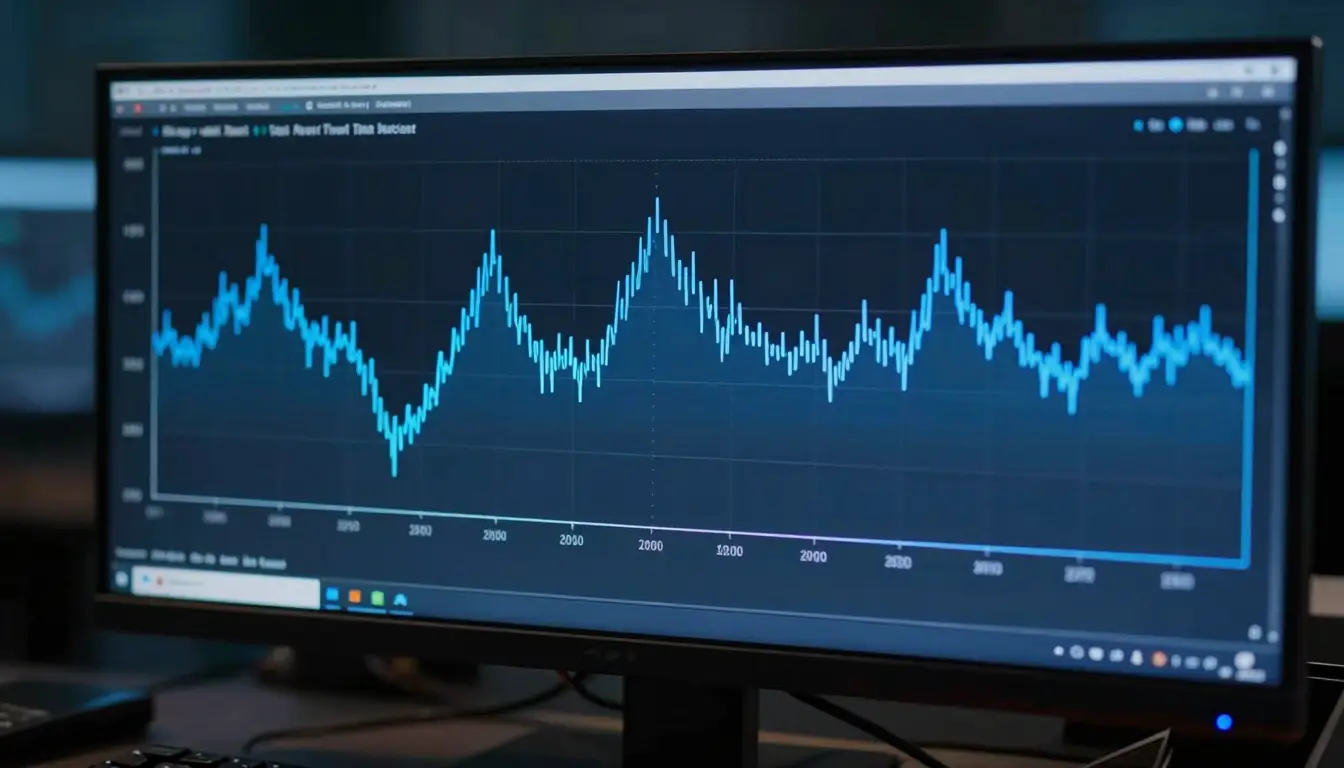
TWAP stands for Time-Weighted Average Price. It is the average price of an asset over a set period, calculated by taking price readings at regular time intervals and averaging them. TWAP is best known as an execution strategy: instead of placing one large order that could move the market, a trader or algorithm breaks it into smaller pieces and releases them evenly over time, aiming to fill close to the time-weighted average price. It is used mainly by institutions and algorithmic traders to buy or sell large positions quietly. This guide explains what TWAP means, how it is used, and how it differs from VWAP.
Key points:
- TWAP is the average price of an asset over a period, sampled at even time intervals.
- As an execution strategy, it splits a large order into equal pieces released steadily over time to reduce market impact.
- Unlike VWAP, TWAP ignores volume and weights every time interval equally.
- It is used mostly by institutions and algorithms to trade large sizes without moving the price.
What is TWAP?
At its simplest, TWAP is just an average price measured evenly across time. If you recorded a share’s price every minute for an hour and averaged those readings, you would have its TWAP for that hour. Because it samples at equal time intervals, every moment counts the same regardless of how much was traded then. The more common meaning, though, is TWAP as an execution algorithm. Here the goal is not to measure a price but to achieve one: to buy or sell a large amount at an average price close to the TWAP over a chosen window, by trading steadily rather than all at once.
How does a TWAP strategy work?
Suppose an institution needs to buy a large number of shares, enough that a single market order would push the price up and cost them a worse fill. A TWAP algorithm solves this by slicing the order into many small pieces and executing them at regular intervals over a set period, say one piece every few minutes across two hours. By spreading the buying evenly across time, it avoids showing a large order to the market all at once, which reduces the price impact and keeps the average fill close to the time-weighted average price. The trade-off is that it takes time, and a fast market move during the window can work for or against the final price.
TWAP vs VWAP
TWAP and VWAP are close cousins, and the difference is what they weight. TWAP weights every time interval equally, ignoring how much volume traded. VWAP, or Volume-Weighted Average Price, weights by volume, so busier periods count more.
| TWAP | VWAP | |
|---|---|---|
| Weights by | Time (each interval equal) | Volume (busier periods count more) |
| Ignores | Volume | Nothing; volume is central |
| Best when | Volume is uneven or hard to predict | You want to track where most trading happens |
| Typical use | Spreading an order evenly over time | Benchmarking fills against volume |
Neither is better in the abstract. TWAP is simpler and can suit assets where volume is erratic or thin, since it does not depend on predicting volume. VWAP is often preferred for liquid shares where following the volume profile gives a fill that better reflects where the market actually traded.
Who uses TWAP, and does it matter for retail traders?
TWAP is mainly a tool for institutions, funds, and algorithmic desks that need to move large positions without disturbing the price. A retail trader buying a few shares has no market impact to worry about, so they rarely need a TWAP algorithm. That said, it is useful to understand for two reasons. First, some retail and crypto platforms now offer TWAP-style order types that let you spread a larger order over time, which can help in thin markets. Second, knowing that large players trade this way helps explain why prices sometimes grind steadily in one direction on no obvious news: a big TWAP order may simply be working through the market. For most retail trades, a simple market or limit order is all that is needed.
Related reading
Frequently asked questions
What does TWAP stand for?
TWAP stands for Time-Weighted Average Price. It is the average price of an asset over a period, calculated from readings taken at equal time intervals so that each interval carries the same weight. The term is used both for that average as a measurement and, more often, for an execution strategy that trades a large order in equal slices over time to achieve a fill near that average.
What is the difference between TWAP and VWAP?
The difference is weighting. TWAP weights each time interval equally and ignores volume, while VWAP weights by volume so periods of heavy trading count more towards the average. TWAP can suit assets with erratic or thin volume because it does not rely on predicting it, whereas VWAP is often preferred for liquid shares where following the volume profile matters. Both are used to execute large orders with less market impact.
Can retail traders use TWAP?
Increasingly, yes. Some retail brokers and many crypto exchanges now offer TWAP-style orders that automatically split a larger order into smaller pieces over a set time. For most retail traders with small positions it is unnecessary, since their orders do not move the market, but it can be useful when trading a larger size in a thin or volatile market where a single order might get a poor fill. For everyday trades, a standard market or limit order is usually enough.
This article is educational and not financial advice. Trading carries risk and most retail accounts lose money. VLT Markets is a publisher, not a broker.