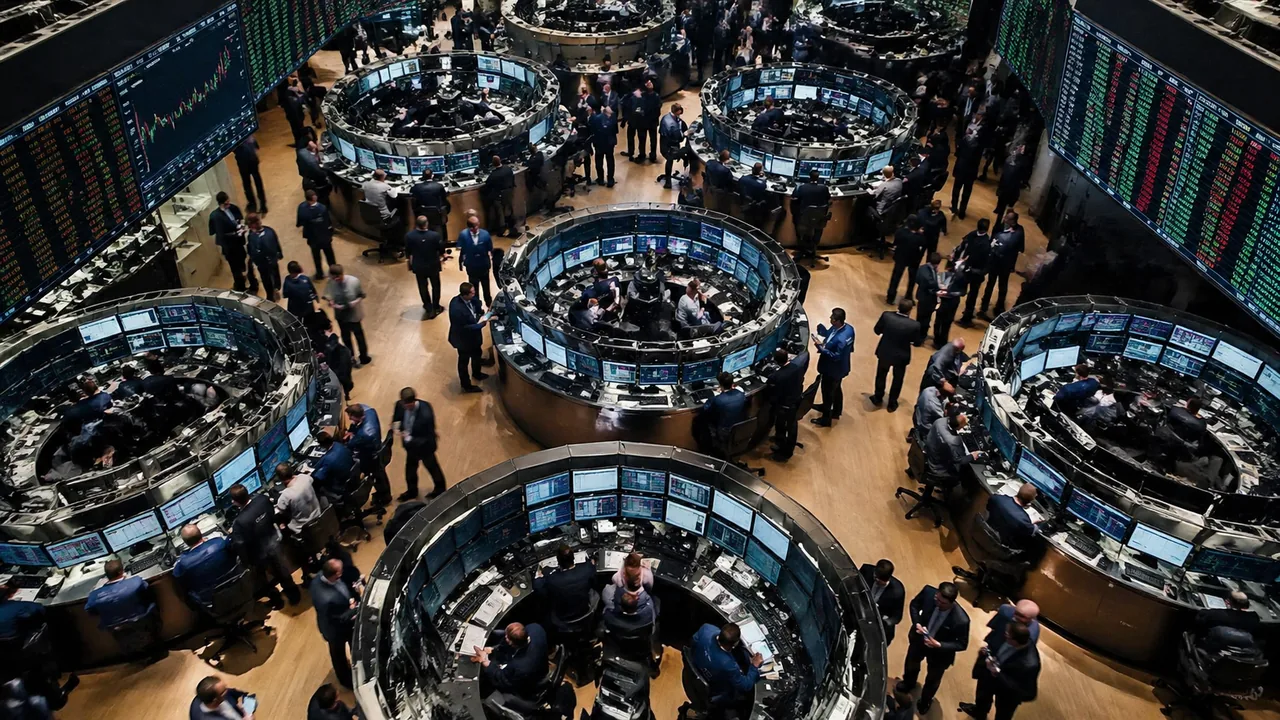
Financial markets are systems where buyers and sellers exchange assets: stocks, bonds, currencies, commodities, and more. They exist in every modern economy and touch most people’s lives through savings, pensions, and business financing, even if you have never placed a trade. Understanding the basics of how they work is useful whether you want to invest, trade, or simply make sense of financial news.
What a market is
A market is any system that allows buyers and sellers to find each other and agree on a price. Financial markets can be physical locations (like a traditional stock exchange floor, though these are largely ceremonial today) or electronic systems matching orders from participants around the world. Prices in financial markets are set by supply and demand. If more people want to buy a share than sell it, the price rises. If more want to sell, it falls. Prices update continuously as new buyers and sellers enter and exit.
The four main asset classes and their characteristics
Financial assets are grouped into four main categories, each with distinct characteristics in terms of risk, return, and behaviour.
Equities (shares/stocks) represent ownership in a company. When you buy a share of a publicly listed company — say a share of a FTSE 100 company — you own a proportional fraction of that business. Your return comes from two sources: capital growth (the share price rising) and dividends (distributions of company profits to shareholders). Equities are historically the highest-returning major asset class over long periods, but also one of the most volatile. A single company’s share can fall to zero if the business fails. Broad equity markets can fall 30–50% in severe recessions before recovering.
Fixed income (bonds) represent loans from investors to governments or corporations. When you buy a government bond — a UK gilt, for example — you are lending money to the UK government in exchange for regular interest payments (the coupon) and the return of your principal at a set maturity date. Bonds are generally less volatile than equities because the payments are contractually fixed. In exchange for this lower risk, they typically offer lower long-term returns. Bond prices and interest rates move inversely: when rates rise, existing bond prices fall, because new bonds pay higher interest and older ones become less attractive.
Currencies (forex) are traded against each other in pairs — GBP/USD, EUR/GBP, USD/JPY. The forex market is the largest financial market in the world by daily volume, exceeding $7 trillion per day. It operates 24 hours a day, five days a week. Businesses use forex markets to exchange currency for international trade. Investors use them to express views on relative economic strength between countries. The forex market is dominated by institutional participants — banks, central banks, hedge funds — with retail trading representing a very small share of total volume.
Commodities are physical raw materials: oil, gold, silver, copper, wheat, natural gas. They trade on dedicated commodity exchanges — the CME in Chicago, the LME (London Metal Exchange) — as well as via futures contracts and, for retail traders, CFDs. Commodity prices are driven by supply (production levels, weather, geopolitics) and demand (industrial activity, consumer consumption). Gold is often held as a store of value and tends to rise during periods of economic uncertainty. Oil prices are closely tied to global economic activity and OPEC production decisions.
How prices are set: supply, demand, bids, and asks
At any moment in a liquid market, there are participants who want to buy (bidders) and participants who want to sell (offers or asks). The highest price any buyer is currently willing to pay is the bid. The lowest price any seller is currently willing to accept is the ask. The difference between them is the spread.
When a buyer and seller agree — a bid meets an ask — a trade occurs and that price becomes the last traded price, which is what you see quoted on financial news sites and trading platforms. If there is more buying pressure than selling pressure, bids rise until sellers are willing to deal, pushing the price up. If selling pressure dominates, asks fall until buyers step in, pushing prices down.
This continuous matching of bids and asks is managed by market makers — financial institutions (often large banks) that commit to providing two-way prices in an instrument, meaning they will both buy and sell at quoted prices. Market makers earn the spread as their compensation for this service and for taking on the risk of holding the instrument between buying and selling.
Who participates in financial markets?
Financial markets involve a wide range of participants, each with different objectives, time horizons, and sizes.
Retail investors are individuals investing or trading their personal savings. They typically transact in smaller sizes than institutional participants and access markets through brokers and investment platforms. Retail investors are the smallest participants by individual transaction size but represent a significant share of market activity in aggregate, particularly in equity markets.
Institutional investors — pension funds, insurance companies, mutual funds, and endowments — manage large pools of capital on behalf of beneficiaries. A UK pension fund might manage tens of billions of pounds across equities, bonds, and alternatives. Their trades are large enough to move prices, and their behaviour shapes medium-term market direction.
Hedge funds are investment vehicles that pursue a wide range of strategies — long/short equity, macro, arbitrage — with the flexibility to use leverage and short positions. They are significant participants in both traditional asset markets and derivative markets.
Central banks — the Bank of England, the Federal Reserve, the European Central Bank — manage national monetary policy and can directly intervene in currency and bond markets. When the Bank of England changes base rates, this flows through to every part of the financial system: mortgage rates, corporate borrowing costs, bond yields, and currency exchange rates.
Market makers — primarily large banks — provide continuous liquidity by quoting two-way prices. Without market makers, buyers and sellers would need to find each other directly, which would make markets illiquid and execution slow.
The role of exchanges vs OTC markets
Not all markets operate through centralised exchanges. Understanding the difference matters for how you access them and what protections apply.
Exchanges are centralised venues with formal listing requirements, trading rules, and oversight from national regulators. The London Stock Exchange (LSE) lists UK equities. The New York Stock Exchange (NYSE) and Nasdaq list US equities. The CME (Chicago Mercantile Exchange) handles futures on commodities, indices, and currencies. Exchange-traded instruments have standardised contract terms, centralised price discovery, and clearing through a central counterparty, which significantly reduces counterparty risk.
OTC (over-the-counter) markets involve bilateral trading between two parties without a centralised exchange. The forex market is the largest OTC market in the world — there is no single exchange where all forex trades occur. OTC bond markets and many derivative markets also operate this way. CFD trading with a retail broker is technically OTC: you are transacting directly with the broker, not through a central exchange. This means the broker sets the price, and there is no external price discovery or central clearing body. FCA regulation governs how brokers must conduct themselves in OTC markets for retail clients.
What market hours mean and why they matter
Different markets operate during different hours, and these hours affect both liquidity and volatility.
Major stock exchanges operate during set hours in their local time zones. The LSE operates 08:00–16:30 GMT (London time). NYSE operates 14:30–21:00 GMT. Outside these hours, shares listed on those exchanges cannot be directly traded, though some brokers offer limited pre-market and after-hours access.
The forex market operates 24 hours a day, five days a week, because currency trading follows the global sequence of financial centres: Sydney, Tokyo, London, New York. The most liquid period is the London/New York overlap (13:00–17:00 GMT), when two of the world’s largest financial centres are simultaneously active. Spreads are tightest and volume is highest during this window. The Asian session (00:00–09:00 GMT) is quieter for European currency pairs, with wider spreads and lower volatility.
Market hours matter because liquidity affects your execution costs. Thin markets mean wider spreads and the potential for larger price gaps between quotes. Trading major instruments during their primary market hours gives you better execution than trading outside those windows.
How financial markets are regulated and what that means for investors
UK financial markets are overseen by two main bodies. The Financial Conduct Authority (FCA) authorises firms, sets conduct rules, and investigates misconduct. The Bank of England’s Prudential Regulation Authority (PRA) oversees the financial stability of major institutions such as banks and insurers.
Regulated markets come with disclosure requirements, trading rules, and investor protections that unregulated markets do not. FCA-authorised firms must meet minimum capital requirements, treat customers fairly, and participate in the Financial Services Compensation Scheme (FSCS), which protects eligible deposits and investments up to specified limits. Before depositing with any broker, checking their regulatory status is one of the most important steps you can take — see our guide on how to choose a trading broker for a detailed checklist.
Investing vs trading: the difference for a complete beginner
These two words are often used interchangeably, but they describe fundamentally different activities with different time horizons, cost structures, and risk profiles.
Investing means deploying capital into assets with the expectation of generating returns over months, years, or decades. An investor buying a globally diversified equity ETF inside an ISA expects that, over a 10 or 20 year horizon, the value of global businesses will increase and their investment will grow. They accept short-term volatility because their time horizon is long. Costs are typically low (an annual fund management fee of 0.07–0.2% for index funds), and there is no ongoing daily management required. This is suitable for building long-term wealth, retirement savings, or capital accumulation.
Trading means buying and selling over shorter timeframes — days, hours, or minutes — with the goal of profiting from price movements. Trading requires active management: monitoring positions, setting stop-losses, managing risk per trade. Trading costs are higher because every transaction incurs a spread or commission, and positions held overnight incur financing charges. The evidence base for retail traders consistently generating positive returns after costs is not encouraging — most retail CFD traders lose money, as required to be disclosed by FCA-regulated brokers. Trading is a skill that takes time to develop and requires genuine understanding of risk management before any real capital is deployed.
For most beginners, investing in a diversified, low-cost fund inside a tax-efficient wrapper (ISA, SIPP) is the more appropriate starting point. Trading should only be considered once you understand both the mechanics and the risk. For more detail on this distinction, see the guide to investing vs trading.
How to start with limited capital: £500 to £2,000
You do not need a large sum to begin engaging with financial markets in a meaningful way. Here is a structured starting point ordered from lowest to highest complexity.
Step 1 — Open a Stocks and Shares ISA and buy a single global index ETF. A Stocks and Shares ISA shelters your returns from UK capital gains tax and dividend tax. A single globally diversified ETF (such as a global all-cap or FTSE All-World fund) gives you exposure to thousands of companies across every major market for an annual cost of roughly 0.1–0.2%. This is the lowest-complexity starting point and suits the majority of beginners. See the guide to ETFs and index funds and ISAs and tax-efficient investing for the practical details.
Step 2 — Open a SIPP for tax-advantaged long-term investing. A Self-Invested Personal Pension benefits from government tax relief: a basic-rate taxpayer contributing £800 receives a £1,000 SIPP contribution after tax relief. For retirement-focused capital, the tax advantage is significant.
Step 3 — Use a demo account to understand trading platforms before putting any money at risk. If you want to explore active trading, spend meaningful time on a demo account before committing real capital. See the guide to demo accounts: what they simulate and what they do not for a realistic assessment.
Step 4 — If moving into active trading, start with the smallest possible real positions. Observe how your holdings behave under live market conditions before scaling up. Most experienced active traders will tell you their first year cost them money — in the form of tuition on mistakes. Keeping those costs low while you learn is the most valuable form of risk management.
How markets connect to the broader economy
Financial markets and the real economy are closely linked, though they do not always move together in the short term. Stock markets reflect expectations about future corporate earnings. When investors expect earnings to rise, share prices tend to rise. Bond markets affect borrowing costs for businesses and governments. Currency markets affect the cost of imports and exports, which feeds directly into inflation. A weaker pound makes imported goods more expensive for UK consumers and businesses. The Bank of England’s interest rate decisions ripple through every part of the financial system, from mortgage rates to bond yields to exchange rates.
Related reading
- Investing vs trading: the key differences and which approach suits you
- ETFs and index funds: the beginner’s case for passive investing
- ISAs and tax-efficient investing: what UK investors need to know
- How to choose a trading broker: the checks that matter before depositing
- Broker regulation: what the licence types mean and which regulators matter
Frequently asked questions
Do I need a lot of money to start investing?
No. Many investment platforms allow you to start with as little as £25–£50 per month through regular investment plans. Even a modest regular contribution to a low-cost index fund, held inside an ISA over years, builds meaningful capital through compound growth. The amount you start with matters less than starting early and keeping costs low. What you should not do is put a large sum into active trading before you understand the costs, risks, and mechanics involved.
What is the difference between a stock exchange and OTC?
A stock exchange — such as the London Stock Exchange (LSE) or NYSE — is a centralised, regulated venue where listed securities are traded under standardised rules with a central clearing body reducing counterparty risk. OTC (over-the-counter) trading happens bilaterally between two parties without a centralised exchange. The forex market is the world’s largest OTC market. CFD trading with retail brokers is OTC — you transact directly with the broker at prices the broker quotes. FCA regulation governs the conduct standards that apply to OTC brokers serving UK retail clients.
What is a market maker?
A market maker is a financial participant — typically a bank or specialist firm — that commits to providing continuous two-way prices (both a bid to buy and an ask to sell) in a given instrument. Market makers earn the spread as compensation for this service and for absorbing short-term inventory risk. Without market makers, buyers and sellers would need to find each other directly, which would make markets illiquid. In retail CFD trading, the broker itself often acts as market maker, taking the other side of client trades from its own book.
How do I find out if a financial firm is regulated in the UK?
Search the FCA register at register.fca.org.uk. Enter the company name or its registration number. An authorised firm will appear as active with its permitted activities listed. If a firm does not appear, or appears as unauthorised, that is a significant warning sign. The FCA also maintains a warning list of firms operating without authorisation. For a full broker due-diligence checklist, see the guide to how to choose a trading broker.