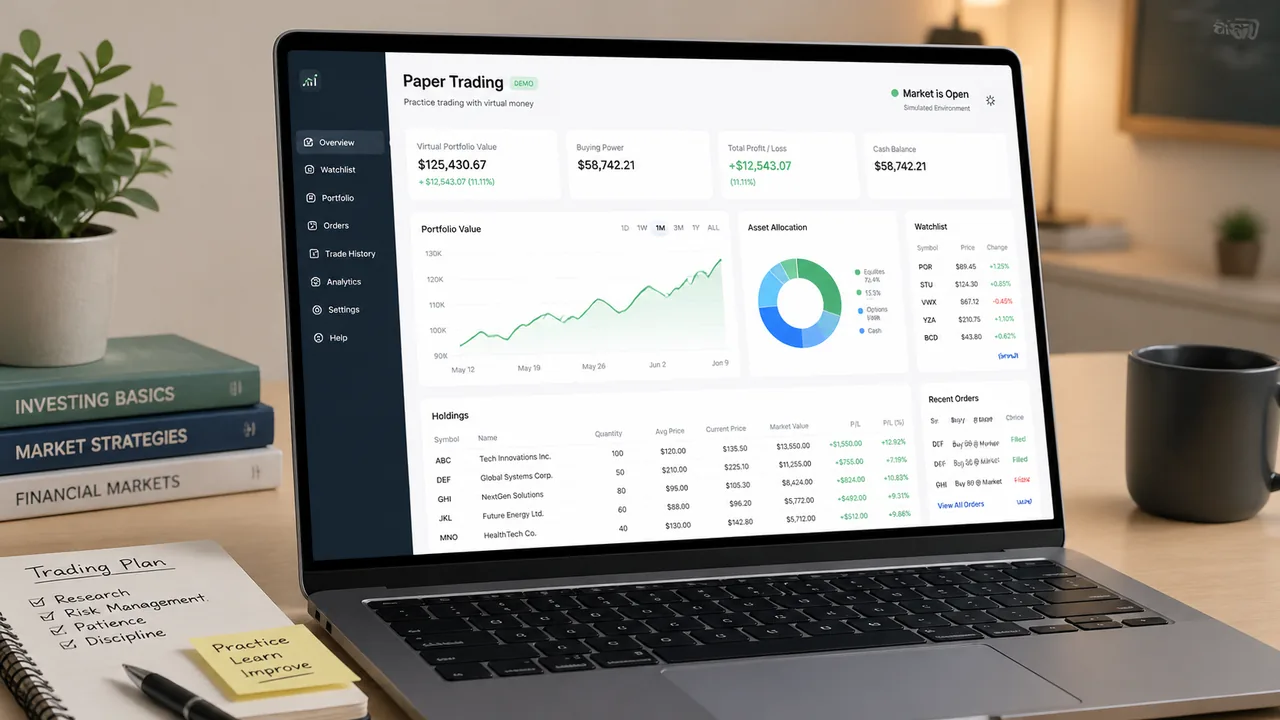
Most brokers offer demo accounts: virtual trading environments where you practise using real market data with simulated funds. They are a standard starting point for new traders and a useful testing ground for strategies. They are also meaningfully different from live trading in ways that matter.
How demo accounts work technically
A demo account connects to the same price feed as the broker’s live platform. Prices displayed are real market prices — or very close to them — sourced from the same liquidity providers that feed the live trading environment. The platform interface, order types, charting tools, and instrument list are identical to what you will use with real money.
The key difference is execution. When you place a trade on a demo account, there is no real order sent to market. The platform simulates a fill at the displayed price, often at the exact quoted price with no slippage. Profit, loss, and account balance update as they would on a live account, but the numbers are entirely virtual. No real capital is at risk and no real capital changes hands.
What demo accounts get right
A good demo account accurately replicates the broker’s platform functionality, the instruments available, the order types, the charting tools, and the speed of the interface. Price feeds are live market prices. This makes demo accounts genuinely useful for learning how to use the platform, understanding how to place different order types, and observing how instruments behave in real market conditions.
For testing a mechanical trading strategy — one with clearly defined entry, exit, and sizing rules — a demo account can give a reasonable sense of whether the rules work in current market conditions before committing real capital. If a strategy consistently produces losses in a demo environment with strict execution discipline, it is almost certainly not viable live. The reverse is less reliable, but more on that below.
The three biggest ways demo trading differs from live
The limitations of demo accounts are specific and predictable. Understanding them before you transition to live trading prevents a set of very common and avoidable surprises.
1. No emotional cost. Losing simulated money feels entirely different from losing real money. The emotional response to drawdowns, the temptation to override rules when a position moves against you, and the difficulty of holding a winning trade all behave differently when real capital is at stake. Demo performance is essentially a measure of mechanical accuracy — how well you can follow your own rules when there is no consequence for breaking them. Live performance is a measure of something harder: how well you can follow your rules when losses are real. A trader who performs well on demo can struggle on live for purely psychological reasons, having never experienced the actual emotional pressure of a position moving against their account. This is the most significant limitation of demo trading and the one most consistently underestimated by new traders.
2. Instant execution without slippage. Demo fills occur at exactly the quoted price. In live markets, particularly during fast-moving conditions or around news events, your order may be filled at a worse price than quoted — this is called slippage. Stop-loss orders in live markets can also fill beyond the set level during rapid price moves (gap risk). These execution differences are most material for strategies with tight stop-losses or that trade around news events. A scalping strategy targeting 3 pips that backtests well on demo may be structurally unviable live if slippage regularly takes 1–2 pips per side.
3. Unlimited capital changes behaviour. Most brokers set demo accounts to a default balance of £50,000, £100,000, or higher — far more than most retail traders actually deposit. A trader practising with £100,000 virtual capital who opens a £5,000 live account is used to position sizes and risk amounts that bear no relationship to their live account. The position sizing habits, the comfort with holding larger positions, and the risk-per-trade amounts that feel normal on demo do not translate. The result is either dangerously large positions relative to the actual account size, or an uncomfortable adjustment to much smaller positions that creates indecision and hesitation.
How to make demo trading more realistic
The gap between demo and live performance is real but not inevitable. Several adjustments narrow it significantly.
Set the demo balance to your intended live deposit. If you plan to start live trading with £2,000, set your demo balance to £2,000. This forces you to size positions the way you will actually size them, develop familiarity with what profit and loss look like at that account size, and understand the practical limits of risk management at your available capital.
Impose a daily loss limit on yourself. Decide before you start each session what the maximum loss you will accept is, and stop trading when you hit it. On demo, there is no external constraint forcing this discipline. Practicing the habit of stopping while it costs you nothing makes it easier to maintain when stopping costs real money.
Record every trade and review it. Keep a trading log with your entry reason, exit reason, size, and outcome. Review it weekly. Identify where your process broke down — trades taken without a valid reason, stops moved in the wrong direction, positions held past your exit rules. The review is what produces improvement; the trading itself is just data collection.
Treat every simulated loss as if it were real. Do not dismiss losing trades with “it does not matter, it is just demo.” If your reaction to a loss is “that does not count,” you are not building the discipline you will need live. Respond to each demo outcome as you would want to respond to a live outcome.
How long should you demo trade before going live?
There is no fixed number of weeks that makes you ready to trade live. The more useful benchmark is behavioural: can you follow your own rules consistently, and can you explain in specific terms why each trade met your criteria before you entered it? If the answer is no, more demo time is needed regardless of how long you have been at it.
Practical signals that suggest readiness to transition:
- You can execute every order type you need — entries, exits, stop-losses, limit orders — without hesitation or error.
- You can articulate the specific rules of your strategy and demonstrate you followed them consistently over at least 30–50 trades.
- You understand the contract specifications of every instrument you trade: margin requirements, overnight financing rates, minimum position sizes.
- You have experienced a losing streak on demo and continued to execute your strategy rather than abandoning it or revenge trading.
- Your demo balance is set to your intended live deposit, and your position sizes are the sizes you will actually use live.
For most people, reaching that level of consistency takes one to three months of deliberate practice. Deliberate means treating each demo session as a real session, recording trades, reviewing them, and identifying where your process broke down. Casual demo trading — placing trades without a plan and moving on — produces no useful data. Developing the discipline required is directly connected to managing the psychological pressures that affect most retail traders.
The demo-to-live transition trap
Profitable demo performance does not predict profitable live performance. This is one of the most consistently confirmed patterns in retail trading, and it trips up a significant proportion of new traders who go live too confidently.
The transition from demo to live is where many traders discover that their demo performance does not carry over. There are four consistent patterns behind this.
First, going live with the same position sizes used on demo. Demo money feels abstract regardless of the balance displayed. Real money at the same notional size creates genuine emotional pressure that changes decision-making. Starting live trading at a fraction of your demo position size is a sensible approach while you adjust to the psychological reality of real capital at risk.
Second, abandoning a strategy after the first live loss that would have been accepted on demo. Every strategy has losing trades. If you would have moved on from the same loss on demo, the loss itself is not the problem. The problem is that real money has changed your relationship to losing.
Third, not accounting for execution differences. Real spreads may be wider than demo quotes during volatile periods. Slippage on stops is real on live accounts and uncommon on demo. Understanding the full cost picture, as covered in the guide to spreads and commissions, sets more realistic expectations.
Fourth, choosing a different broker for live trading than the one you demoed with. Re-learning platform layout, order entry, and risk management tools during live trading adds friction at exactly the moments when clear execution matters most. Use the same broker for live that you practised with on demo, and follow the full verification process in the guide to choosing a broker before depositing.
Related reading
- How to choose a trading broker: the checks that matter before depositing
- Spreads and commissions: how broker costs affect your trading returns
- Trading psychology: how fear and greed affect decisions
- Position sizing: how to calculate the right trade size
- How financial markets work: a guide for complete beginners
- Copy trading explained: how it works, which platforms offer it, and the risks
Frequently asked questions
How long should I demo trade before going live?
The relevant benchmark is behavioural, not time-based. You are ready when you can consistently follow your strategy rules, execute all order types without error, and explain specifically why each trade met your criteria. For most traders practising deliberately, this takes one to three months. Forty to fifty executed and reviewed demo trades is a more useful threshold than any number of weeks.
Do demo accounts use real market prices?
Yes, in most cases. Demo accounts typically connect to the same price feed as the live platform, using real-time market data. Execution, however, is simulated — fills occur at the displayed price without slippage, which does not reflect live market conditions. Prices are real; execution quality is not.
Can I lose money on a demo account?
No. A demo account uses virtual funds. Losses reduce the virtual balance but have no impact on real money. This is both the advantage and the limitation — it allows practice without financial risk, but it also means the psychological experience of losing does not match live trading. Many experienced traders use demo accounts to test new strategies or learn a new broker’s platform, precisely because the absence of financial risk allows objective assessment of the strategy itself.
Can I use a demo account to test a new broker before committing?
Yes, and this is one of the most practical uses. Testing execution speed, platform stability, charting tools, and available instruments before depositing real money is worthwhile even for experienced traders switching brokers. Some execution differences only become apparent under actual market conditions, so time spent on demo at a new broker is rarely wasted. Combine it with the regulatory and cost checks in the guide to choosing a broker before depositing.